














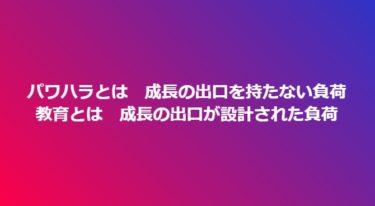
パワハラと教育の境
昨日のゴルフの終了後、一緒にラウンドした大病院の元トップや、いわゆる大企業の社員さんたちとの会話で、パワハラ対策の話が出ました。
組織が大きくなり、多くの人が関わればかかわるほど、言葉のとらえ方は変わります。権利主張を始める人が出てくると、本当に難しいですよね。
パワハラ対策の流れそのものは、出発点としては正しい。
明らかに理不尽な暴力、人格否定、逃げ場のない圧迫から「弱い立場の人」を守る。
これは近代国家として当然の責務です。
本来パワハラとは、
「立場の非対称性を利用して人格を壊し、逃げ道を塞ぎ、尊厳を奪う行為のこと」でした。
ところが今は、
指摘される前に
責任を問われる前に
成果を求められる前に
「それ、パワハラですよね?」
というカードを先に切る部下が出てくる。
これは被害者保護ではなく、評価回避の技術ですよね。
どこかで線がずれてきたのです。
本来、教育には必ず「負荷」があるんですよね。
スポーツも、音楽も、医療も、研究も、経営も。
一定の緊張、失敗、叱責、修正、やり直し——
それを通過しないと「できるようにならない」。
ところが今は、
厳しい指摘=パワハラ
高い要求=圧迫
失敗の指摘=人格否定
と、教育と攻撃の区別がつかない社会になりつつある。
教育自体がパワハラとされて、リスクとなりうるので、
上司は何も言えなくなる
中間管理職が一番消耗する
挑戦的な人材から辞めていく
残るのは「言われないこと」に適応した人だけ
結果どうなるかというと、
「何も言わない上司」
「責任を取らせない組織」
「挑戦させない環境」
が量産される。
これは優しさではなく、放置です。
「弱いものを守る」という大義が、いつのまにか
「強くなるプロセスそのものを否定する」方向に倒れている。
国家の成長も、組織の進化も、人の成熟も、本来は
厳しさ
不均衡
世代間の非対称性
の上に成り立つ。
教える側は常に未熟な相手より強い立場にあるし、その非対称性を前提に「責任を持って導く」ことが教育だったはずです。
今起きているのは、
弱いものを守る
↓
弱いままでいる権利を守る
↓
強くなる努力を要求できない
↓
社会全体が静かに劣化する
という、かなり危うい流れ。
パワハラをなくすことと、教育を成立させることは、本来は両立できる。
必要なのは「厳しさの放棄」ではなく、
目的の共有
評価基準の透明化
人格ではなく行為を問うこと
逃げ道ではなく成長ルートを用意すること
なんですよね。
守るべきは「弱さ」ではなく、強くなろうとする可能性のほうだと思います。
この視点を失った社会は、一見やさしく、内側から静かに衰えていく。いま、その分岐点に立っている感じがします。
パワハラという言葉を
「逃げ道」にしてしまった瞬間、その人は成長のルートを一つ自分で閉じている。
本当に守るべきなのは、
叱られない権利ではなく、
叱られても立ち直れる力のほうなんでしょうね。
The Boundary Between Power Harassment and Education
After yesterday’s round of golf, a conversation with a former top executive of a major hospital and employees from large corporations turned to the topic of power harassment prevention.
As organizations grow larger and involve more people, the interpretation of words inevitably shifts. Once rights-based arguments enter the picture, things become genuinely difficult.
The original intent behind power harassment policies is sound.
They are meant to protect people in vulnerable positions from clearly unreasonable violence, personal degradation, and inescapable pressure.
That is a fundamental responsibility of any modern society.
At its core, power harassment was defined as:
the act of exploiting positional asymmetry to damage someone’s人格, block their escape routes, and strip them of dignity.
But today, a different pattern is emerging.
Before being corrected.
Before being held accountable.
Before being asked for results.
Some subordinates play the card first:
“Isn’t that power harassment?”
This is no longer about protecting victims—it’s a technique for avoiding evaluation.
Somewhere along the way, the line has shifted.
Education, by nature, always involves load.
In sports, music, medicine, research, or management alike.
Tension.
Failure.
Reprimand.
Correction.
Doing it over again.
Without passing through these stages, people simply do not improve.
And yet, we are increasingly living in a society where:
harsh feedback equals harassment,
high expectations equal oppression,
pointing out failure equals a personal attack.
The distinction between education and aggression is being lost.
When education itself becomes a legal or reputational risk, managers fall silent.
Middle management burns out the fastest.
Those with ambition and resilience leave first.
What remains are those who adapt to “not being told anything.”
The result is predictable:
silent supervisors,
organizations that avoid accountability,
environments that discourage challenge.
This is not kindness.
It is neglect.
A principle that began as “protecting the vulnerable” has quietly tipped into
“denying the very process of becoming stronger.”
The growth of nations, organizations, and individuals has always rested on:
rigor,
imbalance,
and generational asymmetry.
Those who teach are, by definition, in a stronger position than those who are learning. Education was never about denying that asymmetry, but about taking responsibility for guiding others through it.
What we are witnessing now is a dangerous sequence:
protect the weak
→ protect the right to remain weak
→ become unable to demand effort toward strength
→ society quietly deteriorates
Eliminating power harassment and sustaining real education are not mutually exclusive.
What is needed is not the abandonment of rigor, but:
shared purpose,
transparent evaluation criteria,
judging actions rather than人格,
and offering growth pathways instead of escape routes.
What deserves protection is not weakness itself, but the potential to become stronger.
A society that loses this perspective may appear gentle on the surface, while slowly eroding from within. It feels as though we are standing at that crossroads now.
The moment “power harassment” becomes an escape hatch,
a person closes off one path of growth for themselves.
What truly needs protecting is not the right to never be scolded,
but the ability to recover—and grow—after being scolded.