












TakahiroFujimoto.com

HOME MAIL
HOME PROFILE BOOKS MUSIC PAPERS CONFERENCES BLOG MAIL CLOSE

BLOG 藤本幸弘オフィシャルブログ

カテゴリー:北米 ボストン編

最終日だけ晴れました

最終日だけ晴れました。

全く景色が違いますね。

気持ちの良いボストンの日差しです。

The sun finally came out on my last day.

It’s amazing how completely the city changes under blue skies.

After several rainy days, Boston suddenly revealed a different side of itself. The historic brick buildings seemed warmer, the streets felt more vibrant, and the Charles River sparkled in the summer light.

It was the kind of sunshine that makes you want to slow down and simply enjoy walking through the city.

A perfect way to say goodbye to Boston.


ノースエンドのNeptune Oysterへ

ボストン最後の昼は、ずっと気になっていた ノースエンドのNeptune Oysterへ。

事前に調べると、「ボストンで一番おいしい」「30分前には並ぶべし」という口コミばかり。

旅行中のレストラン情報は半信半疑で読むことも多いのですが、ここまで皆が同じことを書くなら従ってみようと、スーツケースを引きながら開店35分前に到着しました。

結果は大正解。先頭を確保です。

その後ろには11時の開店を待つ人が次々と並び、扉が開く頃には長蛇の列。

注文したのは名物のジョニーケーキにロブスターをたっぷり載せた一皿。

クラムチャウダー。

そして4種類のオイスター。

なるほど、これは人気になるわけです。

ロブスターは甘く、牡蠣は産地ごとに塩味も香りも違う。

どちらも期待を裏切りませんでした。

それにしても、不思議です。

ステーキは巨大、コーラはバケツサイズ、コーヒーは味より量。

そんな「細かいことは気にしない」食文化に見えるアメリカで、牡蠣だけは別格なのです。

産地、潮の流れ、塩分、ミネラル、収穫時期まで語り始めると、日本のワイン好きにも負けません。

考えてみれば、ニューイングランドは寒流と暖流が交わる世界有数の牡蠣の産地。

ロブスターと牡蠣は、この土地の人たちにとってはハンバーガーではなく、むしろ郷土の誇りなのでしょう。

もちろん、僕は「亜鉛補給です」と言いながら4種類を平らげました。医学的には間違っていません。

でも、本当の目的は、ボストン最後の昼に、この街が何を誇り、何を愛しているのかを味わってみたかったからなのかもしれません。

For my final lunch in Boston, I headed to Neptune Oyster in the North End—a place I had been curious about throughout my stay.

Before going, I had done a little research. Nearly every review said the same thing: “The best seafood in Boston” and “Get there at least 30 minutes before opening.” I usually take travel recommendations with a grain of salt, but when everyone says exactly the same thing, it’s probably worth listening.

So I arrived 35 minutes before opening, suitcase in tow.

It turned out to be exactly the right decision—I was first in line.

Soon, more and more people gathered behind me, and by the time the doors opened at 11 a.m., the line stretched well down the street.

I ordered their famous Johnnycake topped generously with lobster, a bowl of clam chowder, and four different varieties of oysters.

Now I understood why this place is so beloved.

The lobster was wonderfully sweet, while each oyster had its own distinct character, reflecting its origin through subtle differences in salinity, minerality, and aroma. Neither disappointed.

What struck me, though, was something else.

America often seems to celebrate abundance: steaks are enormous, soft drinks come in bucket-sized cups, and coffee is judged more by quantity than subtle flavor.

Yet oysters are treated entirely differently.

People here speak passionately about where they were harvested, the tidal currents, salinity, mineral composition, and even the season in which they were collected. The conversations rival those of serious wine enthusiasts in Japan.

Then again, perhaps it makes perfect sense.

New England is one of the world’s great oyster-producing regions, where cold and warm ocean currents meet. For the people of this region, lobster and oysters are not simply seafood—they are part of their local identity and a source of genuine pride.

As for me, I happily worked my way through all four varieties, joking that I was merely “replenishing my zinc.”

Medically speaking, that isn’t entirely inaccurate.

But perhaps my real reason was something else.

On my final afternoon in Boston, I wanted to taste what this city is truly proud of—and what its people genuinely love.


ハーバード大学とMIT─チャールズ川を挟む二つの知の巨人

最近、海外の企業や研究者、教育関係者の方々から、日本の高等教育機関について質問を受けたり、僕なりの見解を求められたりする機会が増えました。自分でも寄附講座で良いので大学の研究室が持てたらいいなといまだに考えています。

少子化、研究費、大学改革、国際競争力──日本の大学はいま、大きな転換期にあるのでしょう。

だからこそ、学生時代の記憶や人づての話だけで語るのではなく、自分の目で確かめたいと思うようになりました。今年は機会があるたびに各地の大学を訪ね、キャンパスを歩き、研究室を見学し、そこに流れる空気を感じています。

僕の記憶にある大学は、いまも変わらずそこにあるのか。それとも時代とともに大きく姿を変えたのか。その答えは、インターネットの情報ではなく、自分の足で歩いて初めて見えてくる気がしています。

今回は、アメリカ東海岸を代表する二つの大学、Massachusetts Institute of Technology(MIT)とHarvard Universityを訪ねました。

チャールズ川を挟んでわずか数キロ。しかし、この二つの大学が醸し出す空気は驚くほど違います。

MITでは、建物の中を歩いているだけで「何を発見できるか」「何を創り出せるか」という実験精神が伝わってきます。研究室の扉は世界最先端へとつながり、廊下には試作品や研究ポスターが並び、大学全体が巨大な研究所のようです。

レーザー工学の分野では、光干渉断層計(OCT)の開発で世界的に知られる James G. Fujimoto教授の研究室があります。同じ「Fujimoto」という名字ということもあり、以前から勝手に親近感を抱いていましたが、レーザー医学に携わる人間にとってはまさに聖地ともいえる存在です。基礎工学から医療応用までを一気通貫でつなぐ研究スタイルは、MITらしさを象徴しているように感じました。

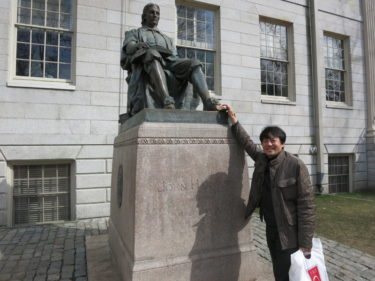
一方のハーバード大学には、約390年にわたる歴史が積み重ねた静かな重厚感があります。1636年創設という歴史は、キャンパス全体に独特の落ち着きを与え、歩いているだけで「知の伝統」に包まれているような感覚になります。

レーザー医療では、Harvard Medical Schoolに所属するMassachusetts General Hospital(MGH)の R. Rox Anderson教授の研究室が世界的に有名です。選択的光熱融解理論を確立し、現代のレーザー皮膚科の礎を築いた研究者であり、友人の医師たちも何人もここで学んできました。

実は僕自身にもハーバードには小さな思い出があります。以前、Harvard Business Schoolで学ぶ事を真剣に考え、アプライしたのですが、しかし最後は約650万円に及ぶ授業料を惜しんで断念しました。当時は高かった。でも今になって振り返ると、「あのとき思い切って飛び込んでいたら、どんな景色が見えただろう」と考えることがあります。人生には、合理的な判断よりも、挑戦そのものに価値がある場面もあるのかもしれません。

興味深いのは、この二校が単なるライバルではないことです。医学、生命科学、AI、医療工学などの分野では共同研究や共同教育プログラムが数多く存在し、互いの強みを融合させながら新しい知を生み出しています。競争と協力が同時に成立している。この関係性こそが、ボストンを世界屈指のイノベーション都市にしている理由なのでしょう。

日本でも大学改革が盛んに議論されています。しかし本当に必要なのは、「どの大学が優れているか」を競うことではなく、「それぞれの大学は社会に何を提供する存在なのか」を明確にすることではないでしょうか。

MITとハーバードを歩いて、僕の心に残ったのは建物の美しさでも世界ランキングでもありませんでした。

大学とは、知識を教える場所ではなく、「知を生み出す文化」を育てる場所である。

その文化は、数字では測れません。キャンパスを歩き、学生や研究者の表情を見て、初めて伝わってくるものなのだと、チャールズ川の風に吹かれながら改めて感じた一日でした。

Harvard and MIT—Two Giants of Knowledge Across the Charles River

Recently, I’ve found myself increasingly being asked by overseas companies, researchers, and educators about Japan’s universities and higher education system, often with requests for my own perspective. Personally, I still hope that one day I might establish a university research laboratory of my own—even if it begins as an endowed research program.

Declining birth rates, research funding, university reform, and international competitiveness—Japanese higher education seems to be at a major turning point.

That is precisely why I no longer want to rely solely on memories from my student days or secondhand impressions. I want to see these institutions with my own eyes. Whenever I have the opportunity this year, I have been visiting universities, walking their campuses, touring laboratories, and experiencing the atmosphere that defines each one.

Are the universities I remember still the same? Or have they evolved with the times?

I have come to believe that the answers cannot be found on the internet. They reveal themselves only by walking the campuses in person.

This time, I visited two of the most distinguished universities on the American East Coast: the Massachusetts Institute of Technology (MIT) and Harvard University.

Separated by only a few kilometers and the Charles River, these two institutions could hardly feel more different.

Walking through MIT, one immediately senses a culture driven by a single question: What can we discover? What can we create? Laboratory doors seem to open directly onto the frontiers of science. Hallways are lined with prototypes and research posters, and the entire campus feels like one enormous research laboratory.

In the field of laser engineering, MIT is home to the laboratory of Professor James G. Fujimoto, whose pioneering work on Optical Coherence Tomography (OCT) has transformed medical imaging. Sharing the same surname, I’ve always felt an entirely personal sense of affinity toward him. For anyone involved in laser medicine, however, his laboratory is nothing short of a place of pilgrimage. His seamless integration of fundamental engineering with clinical applications perfectly embodies the spirit of MIT.

Harvard University, by contrast, possesses the quiet dignity that comes from nearly 390 years of history. Founded in 1636, its campus radiates a sense of intellectual tradition. Simply walking through Harvard gives the feeling of being surrounded by generations of accumulated scholarship.

In laser medicine, one of the world’s most influential laboratories belongs to Professor R. Rox Anderson at Harvard Medical School’s Massachusetts General Hospital (MGH). Professor Anderson established the theory of selective photothermolysis, laying the scientific foundation for modern laser dermatology. Several physician friends of mine have trained in his laboratory, making it one of the most respected destinations in our field.

Harvard also holds a small personal memory for me.

Years ago, I seriously considered attending Harvard Business School and even submitted an application. In the end, however, I decided against it because I couldn’t justify the tuition—approximately ¥6.5 million at the time. It felt expensive then.

Looking back now, I sometimes wonder what I might have experienced had I simply taken the leap. There are moments in life when the challenge itself is worth more than the most rational decision.

What I find particularly fascinating is that these two universities are not merely rivals.

In medicine, life sciences, artificial intelligence, biomedical engineering, and many other fields, Harvard and MIT collaborate extensively through joint research projects and educational programs. They compete, yet they also complement one another, combining their respective strengths to generate new knowledge.

Perhaps that balance between competition and collaboration is precisely what has made Boston one of the world’s leading centers of innovation.

Japan, too, is engaged in an ongoing debate about university reform. Yet perhaps the more important question is not which university is the best, but rather what unique value each university contributes to society.

After spending time at both MIT and Harvard, what remained with me was neither the beauty of the buildings nor their positions in global rankings.

A university is not simply a place that teaches knowledge.

It is a place that cultivates a culture capable of creating new knowledge.

That culture cannot be measured by statistics alone. It is something you begin to understand only by walking the campus, watching the students and researchers, and experiencing the atmosphere for yourself.

That was the thought that stayed with me as I stood beside the Charles River, feeling the breeze between these two remarkable institutions.


西半球にしかいないイキリンコの青

西半球にしかいないイキリンコの青を捕まえました。

米国生誕250周年中なので、お祝いバージョンばかり。

I managed to catch a blue Squawkabilly, a Pokémon found only in the Western Hemisphere.

To celebrate the United States’ 250th anniversary, many of them are appearing in special commemorative versions.

It was a fun reminder that even in a game, local culture and history can become part of the experience.


昨日のお昼ご飯

昨日のお昼ご飯。フィッシュバーガーとロブスタービスク。

白身魚は氷の上に並んでいるコッドですが、見た目よりも遥かに美味しかったです。

写真がうまく撮れていないですね。

ボストンに来るとロブスターばかりに目が行きますが、この街を本当に豊かにしたのは「コッド(タラ)」でした。

17世紀以降、北大西洋で獲れたタラは塩漬けにされて世界へ輸出され、ニューイングランド経済の土台を築きました。

ロブスターが観光のスターなら、コッドはボストンの歴史を支えた名脇役なのです。

またボストンではクラムチャウダーばかりが注目されますが、もう一つ見逃せないのがロブスタービスクです。

ロブスターの殻から何時間もかけて旨味を引き出し、生クリームでまとめた一杯は、海のエッセンスをそのまま閉じ込めたような濃厚さ。

クラムチャウダーが港町の日常なら、ロブスタービスクは特別な日のごちそう。そんな印象を受けました。

Yesterday’s Lunch: A Fish Burger and Lobster Bisque

Yesterday’s lunch was a fish burger and a bowl of lobster bisque.

The fish was cod, displayed on ice before being cooked. It was far more delicious than it looks in the photo—I clearly didn’t do it justice.

When people visit Boston, it’s easy to focus on lobster. But the seafood that truly made this city prosperous was cod.

From the 17th century onward, cod harvested from the North Atlantic was salted and exported around the world, becoming one of the foundations of New England’s economy. If lobster is Boston’s culinary superstar today, cod is the quiet hero that helped build the city’s history.

While Boston is best known for its clam chowder, there’s another local specialty that deserves just as much attention: lobster bisque.

Made by slowly extracting flavor from lobster shells over many hours before being finished with cream, a good lobster bisque captures the very essence of the sea in every spoonful.

If clam chowder is the everyday comfort food of a historic port city, then lobster bisque feels like a dish reserved for special occasions.

That was certainly the impression it left on me.


カテゴリー