














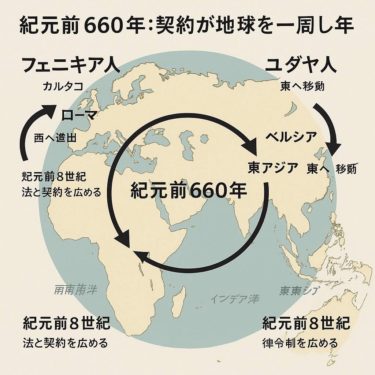
紀元前660年、文明が二つの道を歩き始めた――
ちょっと図が変ですが、世界史好きな僕としては、欧州にいるとこちらの文明に感化され、色々考えてしまいます。
今日は皇紀2685年を迎えた今、2685年前は世界がどう動いていたのか?
チグリスとユーフラテスが生んだ土のメソポタミア文明。
ナイルが磨いた太陽のエジプト文明。
その二つの流れが出会う中間点――そこがカナンの地であった。
この地は、東西の知と信仰が渦を巻く文明の交差点。
象形文字の神々がまだ石に刻まれていた頃、
ここではすでに、人々が自らの声を記号に変え、
アルファベットという音の契約を生み出していた。
①海を選んだ民 ― フェニキア人
カナンの沿岸に住んだフェニキア人は、西に進み海を選んだ。彼らは商船を神殿とし、交易を祈りとした。
ティルからカルタゴへ――
文字を携え、契約の書を胸に、
彼らは地中海を航路で結んだ。
この時代、カルタゴではすでに商法と契約の体系が整い、
人々は「信義」と「記録」で社会を運営していた。
それはやがてギリシャの法に、ローマの理性に、
そしてヨーロッパ文明の根に変わっていく。
フェニキア人は海を通じて「合理の文明」を築いた。
それは、神の命令ではなく、人と人の約束で世界を動かすという思想だった。
②神を選んだ民 ― イスラエル人
一方、カナンの丘陵では、別の民が空を見上げていた。フェニキア人とほぼ兄弟に当たる民
イスラエルの民――彼らは砂漠を越え、神との契約を抱いて歩いた。
紀元前660年の頃、ユダ王国では、若き王ヨシヤが神殿を清め、奥深くに眠っていた「律法の書」を再発見した。
そしてそれを掲げ、国に宣言する。神と民は、再び契約を結ぶ。
その瞬間、信仰は制度となり、宗教は法へと変わった。
カナンは再び、「神と人の約束の地」として息を吹き返したのだ。
イスラエル人は陸を通じて「倫理の文明」を築いた。
彼らにとって世界は、力ではなく、正義と秩序によって支えられるものだった。
③そして極東の島でも
同じ紀元前660年。
はるか東の島、日本では、神話の王・神武天皇が東征を終え、橿原で即位したと伝えられる。
天照大神の子孫として「天と地の契り」を結び、
国を治めると誓ったその神話は、
ヨシヤが神との契約を再確認した同じ時代の呼応であるかのように響く。
この年、地球の両端で――
神と人が新しい秩序を結び直した。
フェニキア人は海で、イスラエル人は砂漠で、そして日本では天の下で。
カナンという文明の子宮
カナンの地は、メソポタミアとエジプトという二つの大河文明のあいだにあった。
その狭間で、人々は“神が語る”時代から“人が記す”時代へと踏み出した。
そこから二つの道が分かれていった。
フェニキア人は海を通じて法と契約を世界に広め、
イスラエル人は陸を通じて倫理と信仰を伝えた。
紀元前660年という一点を起点にして、
文明は西と東に分かれ、それぞれ異なる花を咲かせた。
西の花は理性と制度を、
東の花は秩序と徳を咲かせた。
だが、その根は同じ――カナンの大地である。
結語
文明はいつも、ある一点から分かれ、そして再び交わろうとする。
紀元前660年。
フェニキアの海商、イスラエルの預言者、そして日本の建国者。
彼らは遠く離れながらも、同じ精神の潮流の中にいた。
それは、「神と人の間に約束を結ぶ」という、人類最初の“文明の意思”だったのだ。
いや、もしかしたら二つの起源は一緒だったのかもしれないという意見も多い。
神武天皇の東征は=ユダヤ民族の東方移動の歴史を尺度を変えて示していたのではないか?
日本人は混血で、カナンの血や伝説が入ってきていても何ら不思議はない。
660 BCE: The Moment Civilization Took Two Paths
The diagram may be a bit clumsy, but as a student of world history, I can’t help but reflect—especially here in Europe—on the diverging courses civilizations began to take.
Today marks the year 2685 in the Japanese imperial calendar.
So what was happening 2,685 years ago, in 660 BCE, around the world?
The civilizations of Mesopotamia, born of the Tigris and Euphrates—the civilization of earth.
The civilization of Egypt, shaped by the Nile—the civilization of sun.
Between these two, at the crossroads where earth met sun,
lay the land of Canaan—a womb of civilizations, where East and West began to intertwine.
At a time when gods were still carved into stone in hieroglyphs,
a new shift was underway: here in Canaan, people turned their voices into symbols, creating the alphabet—a contract of sound, not stone.
1. The People Who Chose the Sea – The Phoenicians
The Phoenicians, coastal dwellers of Canaan, looked westward—and chose the sea.
Their merchant ships were their temples; their trade, a form of prayer.
From Tyre to Carthage,
they carried letters, inscribed contracts, and linked the Mediterranean through commerce.
By the 7th century BCE, Carthage had already developed legal and commercial systems,
and society was governed not by divine edict, but by trust and record.
This rational structure influenced the laws of Greece,
the reason of Rome,
and the very foundations of Western civilization.
The Phoenicians built a civilization of reason—
one that moved not by the command of gods,
but by the agreements between people.
2. The People Who Chose God – The Israelites
In the highlands of Canaan, another people lifted their eyes not to the sea, but to the heavens.
The Israelites—brothers of the Phoenicians in origin—traversed deserts, guided by a covenant with their God.
Around 660 BCE, in the Kingdom of Judah,
a young king named Josiah purified the temple and rediscovered the long-forgotten Book of the Law.
He raised it before the people and proclaimed a renewed covenant with God.
In that moment, faith became system, and religion transformed into law.
Canaan again breathed as the land of divine-human contract.
The Israelites built a civilization of ethics.
To them, the world was not held together by power, but by justice and moral order.
3. And on a Distant Eastern Island…
At the same time, in 660 BCE, far to the east,
on an island later called Japan,
a mythical figure named Emperor Jimmu is said to have completed his eastward campaign and ascended the throne at Kashihara.
As a descendant of the sun goddess Amaterasu,
he pledged a covenant between heaven and earth, and vowed to govern in accordance with divine will.
This ancient myth seems to echo across continents,
resonating with Josiah’s rediscovery of the covenant in Judah—
as if, at the same moment in history,
people across the globe were reweaving the bond between the divine and the human.
That year, at opposite ends of the earth—
the Phoenicians on the sea,
the Israelites in the desert,
and the Japanese under the heavens—
all entered into new covenants of order.
Canaan: The Womb of Civilizations
Canaan lay between the two great river civilizations of Mesopotamia and Egypt.
In this narrow corridor, people stepped from an age where gods spoke to an age where humans recorded.
From this land, two paths diverged:
-
The Phoenicians took to the sea, spreading law and contract.
-
The Israelites moved across land, carrying faith and ethics.
From this single historical moment—660 BCE—
civilization began to split into East and West, each flowering in its own way.
The West gave rise to reason and institutions.
The East nurtured order and virtue.
Yet both shared the same roots:
the soil of Canaan.
Conclusion
Civilization often begins at a single point—then splits, wanders, and ultimately seeks reunion.
In 660 BCE,
Phoenician merchants,
Israelite prophets,
and Japan’s mythical founder—
Though far apart in distance,
they were moved by a common current of human spirit.
A spirit that sought to establish a covenant between the divine and the human—
perhaps humanity’s first true civilizational intent.
And perhaps… these origins were not so separate after all.
Some believe that Emperor Jimmu’s eastward conquest reflects the eastward migration of ancient Semitic peoples—a mythological mirror of Israel’s desert journey.
After all, the Japanese are a mixed people.
It wouldn’t be strange if bloodlines or legends from Canaan had found their way into this distant island as well.