














カンタベリーと本能寺 ― 神から王へと移動した瞬間
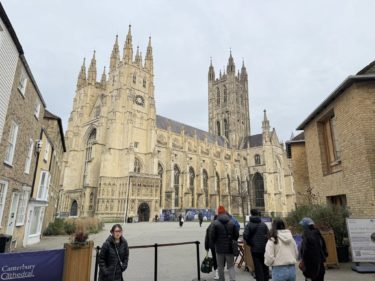
ロンドンから南東へ約1時間、カンタベリーの街に降り立つと、空気の密度が明らかに違うことに気づきます。石畳の静けさの中に、単なる観光地とは異なる、文明の断層のようなものが横たわっています。ここは英国国教会の中心であり、そして1170年、人類史における決定的な事件が起きた場所です。
すべては西暦597年、ローマ教皇グレゴリウス1世が派遣した修道士アウグスティヌス(後の聖アウグスティヌス)が、この地に教会を建てたことに始まります。彼はイングランド初の大司教となり、ここカンタベリーが英国キリスト教の中心となりました。
つまりこの場所は、「英国という国家の精神構造が形成された地点」
といっても過言ではありません。現在でもカンタベリー大聖堂の大司教は、世界約8500万人の英国国教会信徒の精神的指導者です。
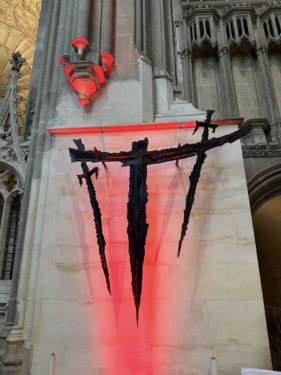
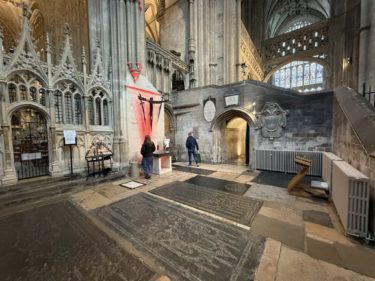
英国最初の大聖堂であるカンタベリー大聖堂の奥へと進むと、トマス・ベケットが殺害された場所に至ります。赤がバックの黒い稲妻のような装飾がある部屋です。王ヘンリー2世の側近であった彼は、大司教となった後、王の意向に反して教会の独立を守ろうとしました。当時のヨーロッパでは、王は地上の支配者でしたが、その正統性は神から与えられるものでした。つまり王は絶対者ではなく、神の秩序の中の一構成要素に過ぎなかったのです。
しかしヘンリー2世は、この構造を変えようとしました。王が聖職者を裁き、宗教を国家の中に組み込むという構想です。その結果、王の意志を忖度した騎士たちが大聖堂に入り、祭壇の前でベケットを斬殺しました。これは単なる暗殺ではありませんでした。それは「神の代理人を、人間の権力が物理的に排除した瞬間」でした。
しかし歴史は単純ではありません。ベケットは殉教者となり、逆に王は精神的敗北を喫します。ヘンリー2世は後に裸足でカンタベリーを歩き、公開の場で贖罪を行いました。つまりこの事件は、王が神を超えようとした試みであると同時に、まだ神の権威が王を支配していたことを示した事件でもあったのです。
この場所に立った時、僕の頭に浮かんだのは織田信長でした。
信長が行った比叡山焼き討ち(1571年)は、日本史における同種の転換点です。それまで宗教は単なる信仰ではなく、軍事力と経済力を持つ独立した統治機構でした。延暦寺は一つの国家であり、本願寺もまた巨大な政治勢力でした。つまり日本においても、権力の正統性は宗教と不可分だったのです。
信長はこれを完全に破壊しました。宗教勢力を軍事的に殲滅し、その上に自らの統治機構を築いた。安土城の天主という概念は象徴的です。「天主」とは、天の主、すなわち神の位置を意味します。それまで日本の権力者は神の代理でしたが、信長は神の外に立つ存在として振る舞いました。
ここに、カンタベリーとの決定的な対比があります。
カンタベリーでは、王は神を殺そうとして、精神的には敗北した。しかし日本では、信長は神の権威を破壊し、現実の支配構造を作り替えることに成功しました。
この違いは、その後の文明の構造を決定しました。西洋では王と神の二重構造が長く続き、やがて近代国家へと移行します。一方、日本では信長以降、宗教は完全に国家の内部に組み込まれ、世俗権力が統治の中心となりました。
しかし興味深いことに、信長自身は本能寺で倒れます。それは、神を否定した者が、自ら神になる前に消えた瞬間でした。
カンタベリーと本能寺。地理的には遠く離れていますが、この二つの場所は同じ問いを投げかけています。それは、権力の正統性はどこから来るのか、という問いです。神から来るのか、それとも人間自身から来るのか。
大聖堂の静寂の中に立っていると、その問いは決して過去のものではないことに気づきます。現代の国家もまた、科学、経済、情報という新しい「神」の上に成立しています。レーザーやAIといった技術を扱う僕自身もまた、その構造の中にいるのだと実感します。
カンタベリーは単なる宗教都市ではありません。そこは、人間が神の座に手を伸ばした瞬間の記憶が、石として保存されている場所なのです。
Canterbury and Honnō-ji — The Moment Authority Shifted from God to King
About an hour southeast of London, when you step into the city of Canterbury, you immediately sense a difference in the density of the air. Beneath the quiet cobblestone streets lies something more than a tourist destination — it feels like a tectonic fault line of civilization. This is the center of the Church of England, and in 1170, it became the site of a decisive event in human history.
It began in 597 CE, when the monk Augustine — later known as Saint Augustine — was sent by Pope Gregory I and established a church here. He became the first Archbishop of England, and Canterbury became the spiritual center of English Christianity.
It would not be an exaggeration to say that this is the place where the spiritual structure of the English nation was formed. Even today, the Archbishop of Canterbury remains the spiritual leader of approximately 85 million Anglicans worldwide.
As you proceed deep into Canterbury Cathedral, the first cathedral of England, you reach the site where Thomas Becket was murdered — a space marked by a striking red backdrop with a black lightning-like design. Once a close advisor to King Henry II, Becket became Archbishop and sought to defend the independence of the Church against the king’s wishes. In medieval Europe, the king was the earthly ruler, but his legitimacy was believed to derive from God. The king was not absolute; he was one element within a divine order.
Henry II attempted to alter that structure. He envisioned a system in which the king would judge clergy and integrate religion into the apparatus of the state. The result was that knights, interpreting the king’s frustration as command, entered the cathedral and cut Becket down before the altar. This was not merely an assassination. It was the moment when human political power physically eliminated a representative of divine authority.
Yet history is never simple. Becket became a martyr, and the king suffered a moral defeat. Henry II later walked barefoot to Canterbury and performed public penance. The incident thus revealed both an attempt by the king to surpass divine authority and the enduring reality that divine authority still constrained him.
Standing there, I found myself thinking of Oda Nobunaga.
Nobunaga’s burning of Mount Hiei in 1571 was a similar turning point in Japanese history. Until then, religion in Japan was not merely faith; it possessed military and economic power, functioning as an autonomous governing force. Enryaku-ji was effectively a state in itself, as was the Hongan-ji. Political legitimacy in Japan, too, was inseparable from religion.
Nobunaga dismantled this structure completely. He militarily annihilated religious forces and built his own governing system upon their ruins. The concept of the tenshu — the central tower of Azuchi Castle — is symbolic. Tenshu literally means “Lord of Heaven,” implying the position of God. Until then, Japanese rulers had acted as intermediaries of the divine; Nobunaga positioned himself as a power existing outside and above that framework.
Here lies the decisive contrast with Canterbury.
In Canterbury, the king attempted to eliminate divine authority but suffered spiritual defeat. In Japan, Nobunaga succeeded in destroying the institutional power of religion and reshaping the structure of rule.
This divergence shaped the subsequent development of each civilization. In the West, the dual structure of king and God endured for centuries, eventually giving way to the modern nation-state. In Japan, after Nobunaga, religion was fully incorporated into the state, and secular authority became the unquestioned center of governance.
Yet there is a final irony: Nobunaga himself fell at Honnō-ji. It was the moment when the man who denied divine authority disappeared before he could become divine himself.
Canterbury and Honnō-ji — geographically distant, yet united by the same question: Where does the legitimacy of power come from? From God, or from human beings themselves?
Standing in the silence of the cathedral, one realizes that this question is not confined to the past. Modern states are built upon new “gods”: science, economics, information. As someone who works with technologies such as lasers and AI, I too am part of that structure.
Canterbury is not merely a religious city. It is a place where the memory of the moment humanity reached toward the seat of God has been preserved in stone.