








雨が上がったので、セントジェームズからテートブリテンまでロンドン散歩。大英博物館でサムライ展やってる様です。明日行ってみよう。
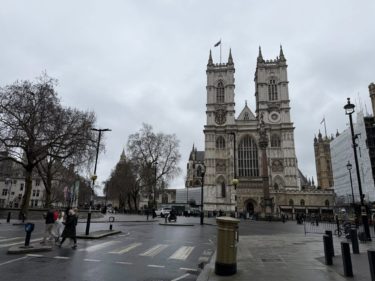
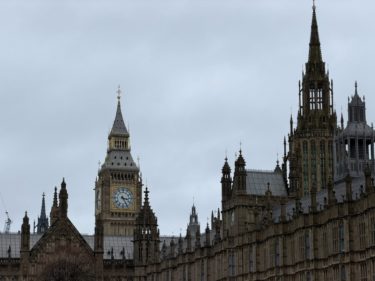
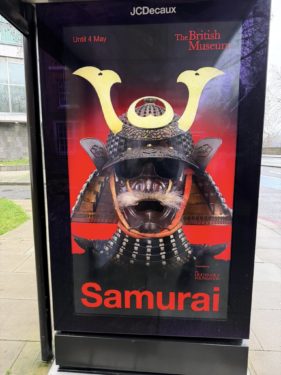
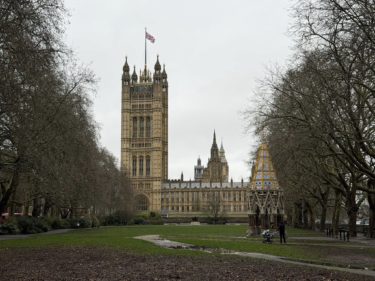
The rain has cleared up, so I’m taking a stroll from St. James to Tate Britain. It looks like the British Museum is holding a Samurai exhibition—I think I’ll head there tomorrow.

 藤本幸弘オフィシャルブログ
雨が上がったので、セントジェームズからテートブリテンまでロンドン散歩。大英博物館でサムライ展やってる様です。明日行ってみよう。
The rain has cleared up, so I’m taking a stroll from St. James to Tate Britain. It looks like the British Museum is holding a Samurai exhibition—I think I’ll head there tomorrow.
ああ、ついに僕も“重圧”を贈られる立場になったのかと、出国前にしみじみ思いました。
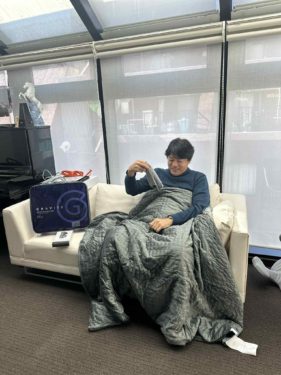
クリニックFのスタッフから「バレンタインです」と手渡されたのは、チョコレートではなく、ずっしりとした布団とアイマスク。その名も“グラビティ・ブランケット”。愛の重みというより、物理的に本気で重いのです。
どうやら「院長、少しは寝てください」という、極めて医学的で、極めて現実的なメッセージらしい。抗酸化でもNMNでもなく、まずは睡眠。さすが臨床の最前線にいるスタッフは処方が的確です。
重い布団に包まれ、重いアイマスクで遮光され、いよいよ僕も強制的に副交感神経優位へ。レーザーも論文も国際学会も、いったん重力に預けよ、ということなのでしょう。
バレンタインに重力をもらうとは思いませんでしたが、これで少しは地に足がつくかもしれません。笑。


Ah, so I’ve finally reached the stage in life where I’m gifted “heavy pressure.” That was my profound realization just before heading abroad.
The staff at Clinic F handed me a Valentine’s gift, but it wasn’t chocolate. Instead, it was a hefty duvet and a sleep mask—specifically, a “Gravity Blanket.” It wasn’t so much the “weight of their love” as it was literally, physically heavy.
Apparently, this was a highly medical and highly pragmatic message: “Director, please get some sleep.” Not antioxidants, not NMN, but simply—sleep. As expected of a team on the front lines of clinical practice; their prescription is spot on.
Wrapped in a heavy blanket and shielded by a weighted eye mask, I am finally being forced into a parasympathetic-dominant state. It seems the message is to leave the lasers, the research papers, and the international conferences behind for a moment and surrender myself to gravity.
I never expected to receive “gravity” for Valentine’s Day, but perhaps this will finally help me stay “grounded.” (Pun intended!)
アイスランドの良いところばかり書きましたが、2点だけどうしてもと言う点があります。9年前に来た時と印象は全く変わりませんでした。
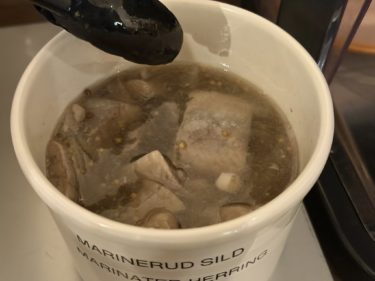
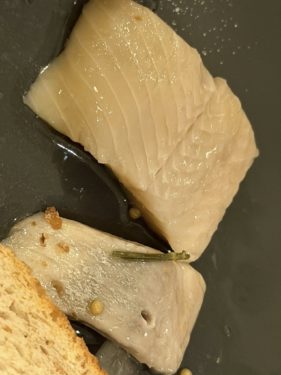
北欧特有の保存文化の塩漬けニシンの低塩発酵、そしてサメの発酵食。スウェーデンのシュールストレミング、そしてアイスランドのハカール。寒冷地でのタンパク源確保という歴史的背景は理解できます。しかし、味覚としてはかなりの個性派です。酸味、発酵臭、アンモニア様の香り。理屈では分かるのですが、日常的に楽しむには相当な慣れが必要でしょう。
ラムのサンドイッチ一皿約5000円。物価の高さは北欧の常ですが、味と価格のバランスが取れているとは言い難い。初訪問時には正直衝撃でした。結果、日本からレトルト食品を持参するという対策に落ち着きました。円安の今でも、やはり高いものは高い。
ちなみに、ニシンはEPA・DHAを豊富に含みますが、発酵魚は塩分負荷が大きい。高塩分食は血圧上昇と心血管リスクに関連することはよく知られています。文化としては尊重しますが、常食としては慎重であるべきでしょう。
もう一つは交通費。空港からレイキャビクの街に行く唯一の手段は空港バスのみ。これが6000円弱。最終日に飛行機の関係で空港から3kmの宿に泊まりましたが、3分乗車でタクシー初乗りが4500円。定額だそうです。10年以上前にロシアで経験したメーター改ざんタクシーよりも高額だったのは、苦笑するしかありませんでした。
アイスランドは人件費が高く、燃料も輸入依存、人口約37万人の小国ですから構造的なコスト高は理解できます。そうは言っても、アイスランド人の平均年収は、約 8万〜9万米ドルで、日本円換算では約 1,200万〜1,400万円前後です。旅行者にとっては心理的ハードルになりますが、それに勝るコンテンツがあるということですね。
円が安いから日本に来たいという観光客を増やすのではなく、魅力があるので高くても来たい国、日本にしたいですね。
While I have focused on the wonderful aspects of Iceland, there are two points I must mention. My impression of these hasn’t changed at all since my first visit nine years ago.
The first is the unique fermented food culture of the North—specifically, low-salt fermented herring and fermented shark. Whether it’s Swedish Surströmming or Icelandic Hákarl, I understand the historical necessity of securing protein in such a harsh, cold climate. However, from a culinary standpoint, they are “acquired tastes,” to say the least. The acidity, the pungent fermented odor, and the ammonia-like aroma—while I understand the logic behind them, enjoying them on a daily basis requires a significant level of mental and physical preparation.
Then there is the cost of living. A single lamb sandwich costs about 5,000 JPY (approx. $33). High prices are a staple of the Nordics, but it’s hard to say the balance between quality and price is always justified. It was a genuine shock during my first visit. This time, I settled on a practical solution: bringing retort-pouch (ready-to-eat) meals from Japan. Even with the weak Yen, expensive things are simply expensive.
From a medical perspective, while herring is rich in EPA and DHA, fermented fish often carries a heavy sodium load. It is well known that high-sodium diets are linked to increased blood pressure and cardiovascular risks. While I respect it as a culture, one should be cautious about making it a dietary staple.
The second point is the cost of transportation. The only real way to get from the airport to Reykjavik is the airport bus, which costs nearly 6,000 JPY. On my final day, due to my flight schedule, I stayed at a lodge just 3km from the airport. The three-minute taxi ride cost 4,500 JPY as a flat rate. I couldn’t help but wryly smile, realizing it was more expensive than the “rigged meter” taxis I encountered in Russia over a decade ago.
Of course, I understand the structural reasons: high labor costs, dependence on imported fuel, and the fact that Iceland is a small nation of only 370,000 people. Furthermore, the average annual income in Iceland is around $80,000 to $90,000 (approx. 12–14 million JPY). While these prices are a psychological hurdle for travelers, it simply proves that Iceland offers experiences powerful enough to outweigh the cost.
Rather than aiming for a Japan where tourists come only because the Yen is cheap, we should strive to make Japan a country where people are eager to visit because of its inherent charm—even if it is expensive.
アイスランド氷上車。

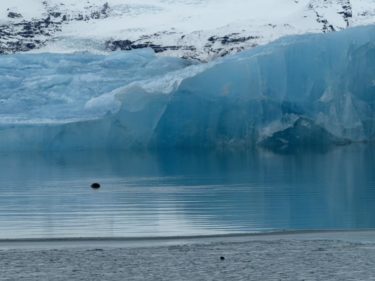
アイスブルーの氷河とアザラシ。
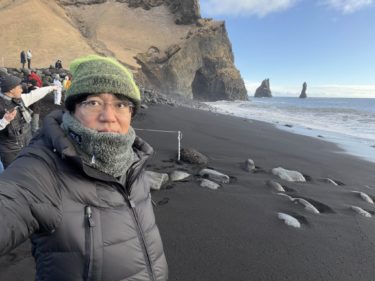
ブラックビーチ。
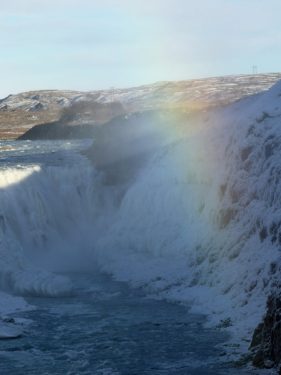
真冬のグトルフォス滝と虹。
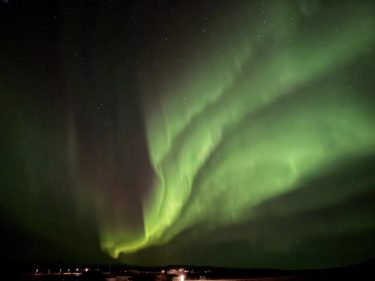
オーロラの色はなぜ緑、赤、青、紫の4系統に変わるのか
アイスランドの夜に立つと、空がゆっくりと呼吸しているように見えます。揺れ、流れ、時に爆発する光。その正体は神秘でも霊的現象でもなく、極めて明快な物理学です。しかし理解すればするほど、むしろ畏敬の念が深まります。
オーロラは、太陽から放出された荷電粒子が出発点です。太陽フレアやコロナ質量放出によって放たれた電子や陽子が地球へ到達し、地球磁場に導かれて極域上空へ流れ込みます。そして高度80〜300km付近の高層大気で酸素や窒素と衝突します。この衝突によって原子や分子が励起され、元のエネルギー状態に戻る瞬間に特定の波長の光を放出します。それが私たちの目に届くのです。
最もよく見られる色は緑です。高度およそ100〜150kmで原子状酸素が出す557.7nmの発光で、典型的なオーロラの色といえます。この波長は「禁制遷移」と呼ばれる特殊な発光過程によるもので、比較的安定した条件で持続的に現れます。
さらに高い200km以上になると、同じ酸素でも630.0nmの赤色光を出します。こちらは大気密度が低く、衝突頻度が少ない環境で起こるため、淡く広く広がる傾向があります。強い磁気嵐のときには、この赤が夜空を覆うことがあります。
活動が強いときには青や紫が現れます。これは高度80〜100km付近で分子状窒素(N₂)やイオン化窒素(N₂⁺)が発光するためです。よりエネルギーの高い電子衝突が起こるときに出現し、動きも速く、躍動的です。複数の波長が重なればピンクや白っぽく見えることもあります。肉眼では淡く、写真では鮮やかに見えるのは、人間の網膜の桿体細胞と錐体細胞の感度差によるものです。
つまり、オーロラの色は大きく分けて緑、赤、青、紫の4系統に分類できますが、実際には高度、粒子エネルギー、磁気活動度、大気組成によって無数のグラデーションが生まれます。色が変わる理由を一言でいえば、「どの高さで、何と衝突したか」によって決まるのです。
地球は巨大な発光装置のような存在です。太陽がエネルギーを送り、地球磁場が粒子を導き、高層大気がスクリーンになります。僕たちはその下で、宇宙規模の実験結果を見上げているにすぎません。
一方で医学的にオーロラの効果を考えると
・オーロラ光自体に有害性は確認されていない
・高緯度の光環境は概日リズムに影響しうる
・磁気嵐と自律神経系の関連は研究途上
・心理的リラクゼーション効果はむしろ期待できる
と、こんな感じでしょうか。
宇宙物理現象を見上げながら、我々の身体もまた電気信号で動いていることを思い出します。オーロラは地球の神経活動のようなものかもしれません。
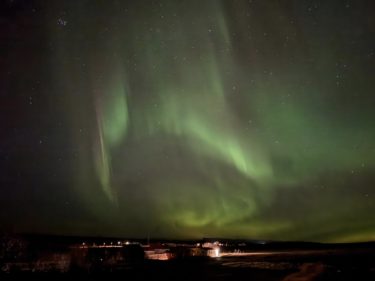
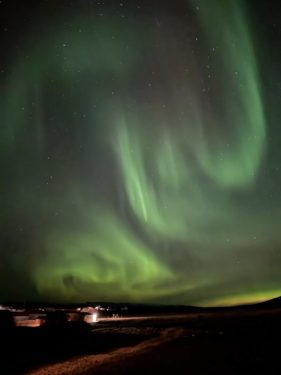
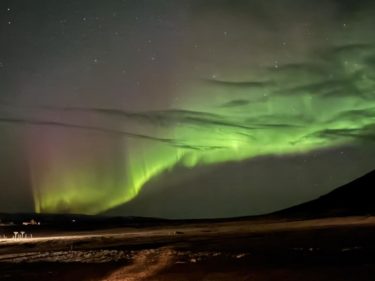
Standing under the Icelandic night sky, it feels as if the heavens are slowly breathing. The lights sway, flow, and occasionally explode. This phenomenon is neither mystical nor spiritual; it is a matter of clear, elegant physics. Yet, the more I understand it, the deeper my sense of awe becomes.
The aurora begins with charged particles ejected from the sun. During solar flares or coronal mass ejections, electrons and protons travel to Earth, guided by the magnetic field toward the polar regions. At altitudes of 80 to 300 km, they collide with oxygen and nitrogen in the upper atmosphere. These collisions excite the atoms and molecules, which release light at specific wavelengths as they return to their ground state. This is the light that reaches our eyes.
The most common color is green. Occurring at altitudes of approximately 100 to 150 km, this 557.7 nm emission comes from atomic oxygen. It is the result of a specific process called a “forbidden transition,” appearing consistently under relatively stable conditions.
Higher up, above 200 km, the same oxygen atoms emit a red light at 630.0 nm. This happens in low-density environments with fewer collisions, resulting in a faint, broad glow. During intense geomagnetic storms, this red can drape across the entire night sky.
When solar activity is particularly strong, blue and violet appear. These are caused by molecular nitrogen ($N_2$) and ionized nitrogen ($N_2^+$) at altitudes of 80 to 100 km. These colors emerge during high-energy electron collisions and are often fast-moving and dynamic. When multiple wavelengths overlap, they can appear pink or whitish. The discrepancy between the faint colors seen by the naked eye and the vivid hues captured in photos is due to the sensitivity difference between the rods and cones in the human retina.
In essence, while auroral colors are categorized into four main systems—green, red, blue, and violet—they actually create infinite gradations depending on altitude, particle energy, magnetic activity, and atmospheric composition. If I were to summarize why the colors change in one sentence: It depends on “at what height” and “with what” the particles collide.
Earth is like a massive light-emitting device. The sun provides the energy, the magnetic field acts as the guide, and the upper atmosphere serves as the screen. We are merely looking up at the results of a cosmic-scale experiment.
From a medical standpoint, the effects of the aurora can be summarized as follows:
No confirmed toxicity from the auroral light itself.
Circadian rhythms may be affected by the light environment at high latitudes.
The link between geomagnetic storms and the autonomic nervous system is still being researched.
Psychological relaxation effects are highly promising.
As I gaze up at this astrophysical phenomenon, I am reminded that our own bodies also operate via electrical signals. Perhaps the aurora is something like the neural activity of the Earth itself.