















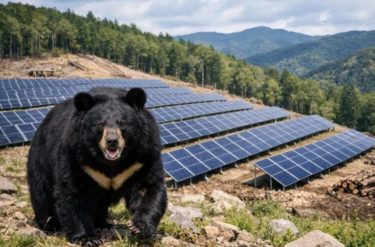
When Mega-Solar Expands, Bears Come into Town
— A Modern Version of “When the Wind Blows, the Cooper Profits”
Recently, there were reports that in Chiba Prefecture, the government’s purchase of electricity generated by mega-solar operators has been revoked.
Apparently, without the state’s high-priced electricity buyback scheme, these businesses can no longer sustain themselves.
What does that even mean?!
Mega-solar power is certainly a meaningful technology in terms of reducing CO₂ emissions and improving energy self-sufficiency.
It’s hard to deny that it offers a “quick and effective solution” toward a decarbonized society.
On the other hand, in Japan, many mega-solar installations are built in forested mountains and satoyama (traditional rural woodlands).
Large-scale logging and the removal of topsoil fragment ecosystems, leaving wild animals such as bears and deer with nowhere to go—pushing them down into human settlements.
Forests also function as natural dams that store water.
Deforestation increases the risk of landslides and flooding. In exchange for solar panels with a lifespan of just 20–30 years, we lose forests that take several decades or more to recover.
Whether renewable energy is truly a “good” depends on where and how it is built.
Electricity meant to protect nature must not be produced by sacrificing nature itself.
That is a question we must not forget.
At first glance, this may sound far-fetched.
Mega-solar and bear sightings.
Renewable energy and wildlife.
1) Mega-Solar Increases
Riding the tailwinds of renewable energy policy, mega-solar projects have been rapidly increasing across Japan.
The sites most often chosen are flat land, inexpensive property, and areas close to transmission lines—in other words, abandoned satoyama and forestland that people no longer use.
2) Forests Are Stripped Away
Installing mega-solar facilities involves widespread logging and the removal of surface soil.
It’s not just trees that disappear.
-
Beech and oak trees that produce acorns
-
Insects and small animals
-
Underbrush and underground water systems
-
Seasonal food cycles
All of these vanish at once.
For bears, it’s as if the “food supply system” they’ve relied on for years suddenly shuts down.
3) The Bears’ Calculations Collapse
Bears are, by nature, highly rational creatures.
They live within roughly the same range every year, carefully calculating where, when, and how much food they can obtain.
Then suddenly, a hillside where acorns fell just last year is covered in black panels.
From the bears’ perspective, this isn’t environmental destruction or government policy—
it’s simply the fact that their feeding ground is gone.
So they descend into human settlements.
There is no food in the mountains.
But in town, there are persimmons.
There are crops.
There is food waste.
Bears don’t enter cities out of ideology or rebellion.
They do so as the shortest path to survival.
4) Humans Say, “There Are More Bears”
In the news, we hear phrases like:
-
“Abnormal bear appearances”
-
“Increase in bear populations”
But in reality, bears haven’t increased—humans have reduced the places where bears can live.
That gap in perception is the core of the problem.
5) What Ultimately Remains Is Culling
The end result is box traps, gunshots, and what is described as “unavoidable measures.”
Under the banner of renewable energy, ecological debt quietly continues to accumulate.
“When the Wind Blows, the Cooper Profits”
This proverb teaches us that cause and effect are not linear—they bend and twist before reaching their outcome.
Well-intentioned policies can, over time, affect distant and vulnerable beings.
Mega-solar and bears may simply be responding to the same “wind.”
In Closing
Few phrases require more careful handling than “environmentally friendly.”
Whether something is truly kind to the environment is determined by what happens to those who cannot raise their voices.
When bears come down into our towns, it is not a rebellion of nature, but a “report of results” from human society.