













TakahiroFujimoto.com

HOME MAIL
HOME PROFILE BOOKS MUSIC PAPERS CONFERENCES BLOG MAIL CLOSE

BLOG 藤本幸弘オフィシャルブログ

BLOG|ブログ

境界が生む知

境界が生む知 ― 混血と創造性の系譜

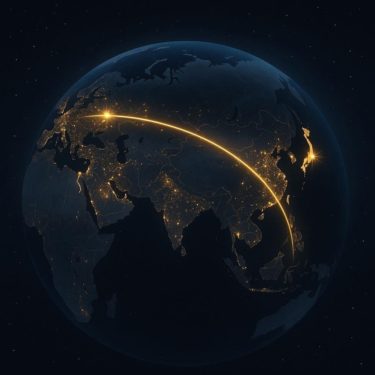
飛行機の窓から見える夜の地球。

僕はいつも思う。

文明の発火点は、いつの時代も「境界」にある。

混ざりあうことFusionで生まれる「知」

創造性とは、異なる要素が交わる場所で生まれる。

それは血の混合にとどまらず、文化、言語、思想の交差でもある。

異なる価値観が衝突し、調和を模索する過程で、新しい発想や表現が芽生える。

混血は、進化の装置であり、文明の触媒でもある。

アレクサンドリアからシリコンバレーへ

歴史を見れば、異文化の融合が文明を加速させてきた。
ギリシャ、エジプト、ユダヤ文化が出会ったアレクサンドリア、イスラムの学問とヨーロッパ思想が溶け合ったルネサンス期のイタリア、そして現代のアメリカ。
異なる血と記憶が交わるとき、そこに「新しい世界を想像する力」が生まれる。

日本 ― 海洋ハイブリッド文明の実験場

日本列島は、アジア大陸と太平洋の接点に浮かぶ「文化の実験場」だ。

縄文と弥生の混血、唐・新羅文化の受容、鎖国下の蘭学、
そして明治の和魂洋才――。

この国の歴史は、外来を拒むのではなく、取り込み、変換し、昇華する連続だった。

漱石の内省、湯川秀樹の理論、宮崎駿の幻想。
いずれも内に潜りながら、世界へ通じる知のかたちである。

ポーランド ― 分割と亡命が育てた知性

ポーランドもまた、東西ヨーロッパの境界に立つ国。

幾度もの分割と亡命を経ながら、

そのたびに文化を再構築してきた。

コペルニクスはドイツ語とラテン語の交わる地で地動説を唱え、ショパンはポーランドの哀しみとフランスのエレガンスを結んで旋律を紡いだ。マリー・キュリーは、国家を越え、科学そのものを祖国とした。

分断は悲劇ではなく、知を磨く試練だった。

境界の民が生む創造

日本とポーランド。

一見遠い二つの国は、どちらも「境界に生きる民」としての共通の感性を持っている。

同化でも排除でもなく、異なるものを受け入れ、対話させ、そこから新しい“中間の知”を生み出してきた。

それこそが、世界を動かす創造のエネルギーだ。

混血とは、身体の中で行われる対話であり、文化の中で繰り返される祈りでもある。

異なる魂、異なる記憶、異なるリズムが交わるとき、文明は呼吸を始める。

日本とポーランド――
その静かなるハイブリッドの地平から、
世界を照らす「境界の知性」が今日も生まれている。
 

The Wisdom Born at the Boundaries — A Genealogy of Hybridity and Creativity

From the airplane window, I gaze down at the Earth at night.

And I always think:
The spark of civilization has always ignited at the boundaries.

Knowledge is born through fusion—the mingling of differences.
Creativity emerges where unlike elements meet.

This mingling is not only of blood,
but also of cultures, languages, and ideas.

When different values collide and search for harmony,
new ways of thinking and expression take root.

Hybridity is an engine of evolution,
a catalyst for civilization itself.


From Alexandria to Silicon Valley

History shows that cultural fusion has always accelerated civilization.

Alexandria, where Greek, Egyptian, and Jewish cultures converged.
Renaissance Italy, where Islamic scholarship blended with European thought.
And modern America, the crucible of countless heritages.

Whenever different bloodlines and memories intertwine,
the power to imagine new worlds is born.


Japan — A Maritime Laboratory of Hybrid Civilization

The Japanese archipelago floats at the intersection
of the Asian continent and the Pacific Ocean—
a laboratory of culture.

The fusion of Jōmon and Yayoi peoples,
the adoption of Tang and Silla culture,
the study of Dutch science under isolation,
and the Meiji spirit of Japanese soul, Western learning

Japan’s history is not one of rejection,
but of absorption, transformation, and transcendence.

The introspection of Sōseki,
the theories of Hideki Yukawa,
the dreams of Hayao Miyazaki—
each is a form of knowledge
that turns inward yet speaks to the world.


Poland — The Intellect Forged by Partition and Exile

Poland, too, stands at the border between East and West.

Through repeated partitions and waves of exile,
it has rebuilt its culture again and again.

Copernicus proposed his heliocentric vision
in a land where German and Latin converged.
Chopin wove the sorrow of Poland
with the elegance of France.
Marie Curie transcended nations
and made science itself her homeland.

Division was not tragedy—
it was the trial that sharpened the mind.


Creativity Born from the Borderlands

Japan and Poland—
two nations distant on the map,
yet sharing the same sensibility of borderland peoples.

Neither assimilation nor exclusion,
but a dialogue between differences—
and from that dialogue, a new knowledge of the in-between emerges.

That is the very energy that moves the world.

Hybridity is a conversation carried out within the body,
and a prayer repeated within culture.

When different souls, memories, and rhythms meet,
civilization begins to breathe.

Japan and Poland—
from their quiet, hybrid horizons,
the intelligence of the boundary continues to illuminate the world today.


世界三大宗教

世界三大宗教って?

今や キリスト教、イスラム教、仏教じゃないんですね。

現在猛追中のイスラム教徒の数。ニューヨーク市長も。2050年にはキリスト教とイスラム教が30億人でぼぼ同数になるそうです。

そして現在ヒンドゥー教は12億人。

仏教は5億人。

今や仏教信者は世界人口の10%を切ったのです。世界常識は仏教的な思考ではないと考えるのが妥当かもしれません。


What are the three major world religions?

It seems they are no longer simply Christianity, Islam, and Buddhism.

The number of Muslims is growing rapidly — even the Mayor of New York is Muslim. By 2050, it’s said that the numbers of Christians and Muslims will each reach about 3 billion, making them roughly equal in size.

Currently, there are about 1.2 billion Hindus and 500 million Buddhists.

Today, Buddhists make up less than 10% of the world’s population.
It might be reasonable to say that global common sense is no longer based on Buddhist ways of thinking.


科学少年の帰還

「科学少年の帰還 ― 観察者から発信者へ」

理科が好きだった少年時代の僕。

学研の『科学と学習』を卒業したあと、自宅には創刊0号から『Newton』が揃っていた。学研の付録の万華鏡や顕微鏡を覗き込みながら、光の粒子や磁力線の不思議に夢中になっていたあの頃。今思えば、その瞬間こそが僕の科学への旅の始まりだったのかもしれない。

「Newton」創刊号(1981年5月号)は、まさに日本におけるサイエンス・リテラシーの象徴とも言える存在だった。(Newton, 1981, Vol.1, No.0)。

最近、ふと書店で手に取った新刊のNewton別冊を読んでいて、気付いた。

――ああ、今の自分の知識のほうが明らかに新しいのだ。

少年のころ憧れた「Newton」や「科学の先生」の世界が、いつの間にか自分の背後に来ている。今は知識を「得る側」ではなく「発信する側」に立っているのだ。

レーザー医学会の国際学会でも、登壇者と「セイハロー」はするものの、話の内容はすでに自分の研究範囲内。もはや“知識をもらいに行く場”ではなく、“仲間に挨拶をしに行く場”になってしまった。

科学を学ぶ少年は、いつしか科学を創る大人になった。
そして、科学の書を読む読者は、いまその書を書く側にいる。

時の流れは不思議だ。あの頃ページの隅に書き込んでいた「光とは何か」という問いを、いま臨床の現場で、レーザー治療や再生医療という形で、日々追い続けているのだから。


“Return of the Science Boy — From Observer to Messenger”

As a boy, I was fascinated by science.
After graduating from Science and Study—the educational magazine published by Gakken—our home library soon filled with every issue of Newton, starting from its very first, the “Issue Zero.” I would peer through the kaleidoscopes and microscopes that came as Gakken’s science-kit supplements, utterly absorbed by the mysteries of light particles and magnetic lines. Looking back now, I realize—that was the very beginning of my journey into science.

The inaugural issue of Newton (May 1981) was, in many ways, a symbol of scientific literacy in Japan itself. (Newton, 1981, Vol.1, No.0)

Recently, while browsing at a bookstore, I happened to pick up a new Newton special edition.

As I turned the pages, a quiet realization came over me.

—Ah, my own knowledge has already surpassed what’s written here.

The world of Newton and the “science teachers” I once admired as a child now stands behind me. I am no longer merely a receiver of knowledge—I have become one who sends it out into the world.

At international congresses on laser medicine, I greet speakers with a casual “say hello,” yet their presentations now fall within the scope of my own research. These gatherings are no longer places where I go to receive knowledge, but rather where I go to greet my peers.

The boy who once studied science has grown into an adult who now creates it.
The reader who once turned the pages of scientific books now stands among those who write them.

Time flows in mysterious ways.
The question I once scribbled in the corner of a page—“What is light?”—is the very question I still pursue today, in the clinical field, through laser therapy and regenerative medicine.


虫の声

夜の草むらに響くシンフォニー ― 虫の声のオーケストレーション

帰国したら一気に秋になっていた。

昨晩、コンサート帰りにほろ酔いで歩いていると、どこからともなく「リーン、リーン」という秋の調べが聞こえてくる。

耳を澄ませば、その背後には低く響く「ギーッギーッ」という低音と、かすかな「チンチロリン」という高音。

思えば古来、日本人は虫の声を“noise(雑音)”ではなく“music(音楽)”として聴いてきた。

西洋の人々が夜の虫を「静寂を破る音」と感じるのに対し、私たちは「静寂を彩る音」として心の内に受け入れてきた。

これは、脳の可塑性と文化的聴覚の融合が生んだ感性だろう。

まるでそれぞれが音域を分担しながら、夜の森全体をひとつのオーケストラとして演奏しているようだ。

■ 自然が生み出した音の「棲み分け」

実際、この響きの秩序には科学的な裏づけがある。

生態学には「音響ニッチ仮説(Acoustic Niche Hypothesis)」という概念があり、昆虫たちは互いの鳴き声が重ならないように、進化の過程で周波数帯を棲み分けてきたとされる(Riede, Journal of Animal Ecology, 1997, pp. 879–892)。

スズムシは6〜8kHzの澄んだ高音、コオロギは3〜6kHzの中音、
そしてクツワムシは2〜3kHzの低音を担当する。

これにより、同じ夜空の下でも彼らの声は混ざり合うことなく、立体的に響く。

自然界が作曲した「多声的生態系」——まさにそれは、生命の調和そのものだ。

■ 聴く側の脳が生む「調和」の幻影

さらに興味深いのは、人間の脳がこの音の重なりを“和音”として感じることだ。

京都大学の神経科学の研究(Takahashi et al., Neuroscience Letters, 2009, pp. 112–118)によると、倍音構造をもつ自然音を聴くと、脳の前頭連合野が“快”の感覚を伴って反応するという。

つまり、虫たちが無意識に奏でる声のハーモニーは、私たちの脳が「美しい」と感じる構造に偶然にも一致しているのである。

■ 音の生態系としての夜

夜の虫の合唱は、単なる音の重なりではない。

カネタタキの短い打音はリズムを刻み、スズムシは旋律を紡ぎ、クツワムシが低音の土台を支える。

それはバイオリン、フルート、チェロの関係に似ている。

さらにこの重層構造は、捕食者に対しての“音のカモフラージュ”としても機能する(Narins et al., Proc. R. Soc. B, 2004, pp. 125–132)。
つまり、自然界の音楽には、美しさと防御の二重構造があるのだ。

■ 結語 ― 自然という作曲家

虫たちは進化の中で、互いの声を聴きながら棲み分けを繰り返し、やがて「重ならない音の世界」を作り上げた。

それを調和として感じ取る人間の脳——。

この両者の間にある共鳴こそ、生命の音楽と呼ぶにふさわしい。

夜風が通り抜けるたび、音の層がわずかに揺れる。

それはまるで、自然という作曲家が指揮棒をそっと振るう瞬間のように思えた


A Symphony Resonating in the Night Grass — The Orchestration of Insect Voices

When I returned home, autumn had already arrived.

Last night, slightly tipsy after a concert, I was walking when I began to hear a faint “leen, leen” — the song of autumn — drifting from somewhere unseen.

As I listened more closely, I noticed a low “gee-gee” humming beneath, and a delicate “chin-chiro-rin” twinkling above it all.

It struck me that, since ancient times, the Japanese have not heard insect sounds as noise but as music.

While people in the West might perceive these nocturnal chirps as “sounds that disturb the silence,” we have come to accept them as “sounds that color the silence.”

Perhaps this sensibility was born from the fusion of neural plasticity and the cultural shaping of our hearing.

It is as if each insect takes on a specific tonal range, performing together as a single orchestra of the nocturnal forest.


The Natural Partitioning of Sound

In fact, there is a scientific basis for this order in sound.

In ecology, there is a concept called the “Acoustic Niche Hypothesis.”
It proposes that, through evolution, insects have come to occupy distinct frequency ranges so their calls do not overlap (Riede, Journal of Animal Ecology, 1997, pp. 879–892).

The bell cricket (suzumushi) sings in clear high tones around 6–8 kHz,
the field cricket (koorogi) in the middle range of 3–6 kHz,
and the katydid (kutsuwa-mushi) in the low range of 2–3 kHz.

Thus, even under the same night sky, their voices blend without interference, resonating in three dimensions.

It is a polyphonic ecosystem composed by nature itself — a true harmony of life.


The Illusion of Harmony Created by the Listener’s Brain

Even more fascinating is that the human brain perceives this layering of sounds as harmony.

According to a neuroscience study from Kyoto University (Takahashi et al., Neuroscience Letters, 2009, pp. 112–118),
when we listen to natural sounds that contain harmonic structures, the prefrontal cortex responds with sensations of pleasure.

In other words, the harmony unconsciously produced by insects happens to coincide with the very structure our brains interpret as “beautiful.”


The Night as an Acoustic Ecosystem

The chorus of insects at night is more than a mere overlap of sounds.

The clicking of the kanetataki keeps rhythm,
the suzumushi weaves melody,
and the kutsuwa-mushi supports it all with a deep, resonant foundation.

Their relationship is like that of violins, flutes, and cellos in an orchestra.

Moreover, this multilayered soundscape functions as an acoustic camouflage against predators (Narins et al., Proc. R. Soc. B, 2004, pp. 125–132).
Thus, the music of nature embodies both beauty and defense — an elegant dual structure.


Epilogue — Nature, the Composer

Through countless generations, insects have evolved by listening to one another, dividing their sonic space, and eventually creating a world of sounds that never overlap.

And humans, in turn, perceive that separation as harmony.

The resonance that arises between these two — the insects and our own perception — is nothing less than the music of life.

Each time the night breeze passes, the layers of sound tremble ever so slightly.

It feels as though the great Composer called Nature is gently lifting its baton to conduct the symphony once more.


自律神経にいいこと

新国際学会周遊記

「自律神経を整える食の科学 ― オンとオフを切り替える食材選び」

先日、取材を受けた雑誌が送られてきました。テーマは「自律神経の働きに良い食材」について。

体調をオンにしたいとき、あるいはオフにしてリラックスしたいときに、どのような食材を摂れば良いか──そんな実践的な視点からまとめています。

僕が最初に英文論文を書いたのは1999年。テーマはまさに「自律神経」でした。

あれから四半世紀。レーザー医療や再生医療、光刺激による神経制御の研究を経て、今回は栄養学との接点からこのテーマを再び取り上げる機会をいただいたのは、何か不思議な縁を感じます。

自律神経と食のバランス

交感神経が優位な「オン」の状態では、エネルギー代謝を高めるためにビタミンB群やカフェイン、カプサイシンなどを含む食材が効果的です。

一方で、副交感神経を高め「オフ」にしたいときには、トリプトファンやマグネシウム、GABAなどを多く含む食材が良いバランスをもたらします。

こうした食の選択が、自律神経のスイッチを柔軟に切り替える手助けとなるのです。

まさに“食による生理学的マインドフルネス”といえるかもしれません。

研究の原点に戻る感覚

今回の取材では、科学的エビデンスとともに、臨床現場での実感を織り交ぜてお話ししました。

自律神経という見えないネットワークが、光・音・食といった外界からの刺激とどう共鳴しているのか。

そのリズムを理解することが、現代人のウェルビーイングの核心につながると改めて感じます。

雑誌はすでに全国の書店やオンラインで入手可能とのこと。

よろしかったらぜひお読みくださいね。


The Science of Food for Balancing the Autonomic Nervous System — Choosing Ingredients to Switch Between ‘On’ and ‘Off’”

The magazine that recently interviewed me has just arrived.
The theme of the feature is “foods that support the function of the autonomic nervous system.”

When we want to switch our bodies on and be active—or off to relax—what kinds of foods are best to eat?
This article summarizes that question from a practical, science-based perspective.

The first academic paper I ever wrote—in 1999—was actually on this very topic: the autonomic nervous system.
A quarter century has passed since then.
After years of studying laser medicine, regenerative medicine, and neural modulation through light stimulation, it feels almost like fate that I’ve come full circle to revisit this theme again, now from the perspective of nutrition science.


The Balance Between the Autonomic Nervous System and Food

When the sympathetic nervous system is dominant—the “on” state that activates energy metabolism—foods rich in B vitamins, caffeine, and capsaicin can be effective.

Conversely, when you wish to enhance the parasympathetic system and shift into an “off” or relaxed mode, foods containing tryptophan, magnesium, and GABA help bring balance.

Choosing such ingredients allows us to flexibly switch the body’s autonomic “modes.”
It could even be described as a kind of “physiological mindfulness through food.”


Returning to the Roots of My Research

In this interview, I spoke about both scientific evidence and clinical experience—how this invisible network of the autonomic nervous system resonates with external stimuli such as light, sound, and food.

Once again, I was reminded that understanding this rhythm may be the key to modern human well-being.

The magazine is now available at bookstores nationwide and online.
If you have a chance, I hope you’ll take a look.


カテゴリー