













クリニックFにシャインマスカットが届いていました!ありがとうございます。


 藤本幸弘オフィシャルブログ
クリニックFにシャインマスカットが届いていました!ありがとうございます。
先週企画したワイン会。そのお礼にと歯科業界の雄である西尾社長がクリニックFに、歯ブラシを箱で送ってくださいました。
毎日誰もが使う歯ブラシに対して、今や多くの人が使っている奇跡の歯ブラシ。さらにそれに対となる夜用MOON歯ブラシを作るとは!


まさに天才的なマーケティング能力ですね。早速使ってみます。
The wine event I organized last week turned out great, and as a thank-you, President Nishio—one of the leading figures in the dental industry—sent a whole box of toothbrushes to Clinic F. These “miracle toothbrushes,” which so many people now use, are for something as ordinary as brushing your teeth, something everyone does every day. And on top of that, he even created a complementary nighttime MOON toothbrush! His marketing sense is truly remarkable. I’ll start using them right away.
今日は誰もが知る外資系企業への「男性のメンタルヘルス」に対するZOOM講演でした。


持ち時間1時間ギリギリまで話しました。
Macintoshが落ちた時用にリザーブも用意して臨みましたが、3名の方の質疑応答まで無事終了。
思えば僕自身も男性更年期世代の真っ只中。資料をまとめる上での気づきも沢山ありました。
関係者の方々には感謝申し上げます。
It was a Zoom lecture on men’s mental health for a well-known global company, and I ended up speaking almost right up to the one-hour limit. I even prepared a backup device in case my Macintosh crashed, but everything went smoothly, including the Q&A session with three participants.
Come to think of it, I myself am right in the middle of the male menopause generation, so I gained many insights while putting the materials together. I’d like to express my gratitude to everyone involved.
ゴルフの第三のヒンジ理論 —— 肩・手首・親指でつくる、“ふわりと飛ぶ”新しいスイング
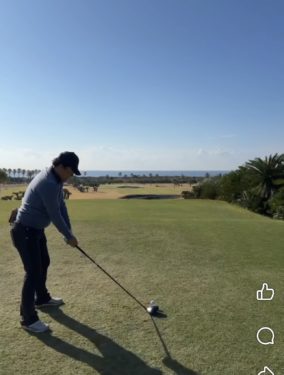
僕が300ヤードを飛ばそうと思う時に必ずやる事。
肩の回旋と手首のヒンジという、いわばゴルフの王道メカニクスに、親指でつくるもう一つの小さなヒンジを加えると、ヘッドの走り方がまるで変わるのだ。
これは文献に載っていたわけではなく、自分自身がスイングの感覚から思いついた“私案”である。
けれど、医工学の視点で文献をあたってみると、この仮説を裏付けてくれそうなデータが思いのほか多い。
今日は、その三重ヒンジの話を少しだけやわらかく書いてみたい。
■ 1. 肩の回旋がエンジンをつくる
体幹の回旋がスイング全体のエネルギー源であることは、三次元解析として示されている。
肩をゆっくり大きく回していくと、身体の奥に下半身と上半身の“しなり”が蓄えられ、ダウンスイングのときにふわっと前へ押し出される感覚がある。
これが最初のヒンジだ。
■ 2. 手首のヒンジは最後のギア
トップの位置で角度を保ち、切り返しからインパクト前にかけてほどける wrist hinge は、ヘッドスピードの最終加速に関わる。
いわば、手首のためを作り、「最後にひと押し」入れてくれることで、クラブは軽く走り出す。
第二のヒンジである。
通常のゴルフスイングは体幹の中央から手首までと、手首からヘッドまでのシャフトの二つのヒンジによって大きく加速がなされる。
■ 3. 親指でつくる“第三のヒンジ”
そして、ここからが私案の部分。
グリップしたとき、親指の付け根にそっとシャフトを乗せ、インパクト直前にほんの少し「押し返すような感覚」を添える。
親指でシャフトの捻りを受け止めて、それを押し返すイメージです。
握力の違いはあるかもしれないけれど、トラックマンで測るとヘッドスピード3m以上速くなります。
剣道をやっていたので、竹刀を指に乗せる感覚に慣れている。
この小さな支点が、
・前腕の回内外
・手関節の掌背屈
・クラブの遅れ(lag)の調整
と重なり、ヘッドが最後にもう一段加速するように感じられる。
この親指ヒンジそのものを扱った研究はまだないが、近しい概念として、手首と前腕の複合運動がヘッド加速度を変えることは研究でも示されている。
私の“第三ヒンジ”は、こうした既存の力学の延長として自然に説明がつく。
ただし、この打ち方をするとシャフトのシナリの戻りがインパクトまでに間に合わないので、フェードかスライスっぽい弾道になるので要注意です。
飛ぶけれど、当然方向性の精度は落ちる。
■ 4. ただし土台はスイングプレーン
三つのヒンジが活きるのは、スイングプレーンが揃っているときに限られる。
プレーンが乱れるとトルク伝達が落ちることは、過去も報告されており、複合的な動きを使うほど、この影響は大きくなる。
肩、手首、親指——
それぞれのヒンジが“同じレール上”でほどけるとき、
スイングはもっと楽に、もっと美しくなる。
■ 5. 終わりに
医療や工学の世界でも、現場でふっと思いついた仮説があとから文献で支えられて“形”になることがある。
この三重ヒンジの感覚も、そんな芽生え方をした。
肩で大きく、手首でしなやかに、そして親指でそっと添える。
もしこれが安定して再現できるようになれば、300ヤードの世界が、少し現実味を帯びてくるかもしれない。
Screenshot

The Third Hinge Theory in Golf — A New Swing Built from the Shoulder, Wrist, and Thumb for a “Floaty” Launch
There’s one thing I always do when I want to carry the ball 300 yards. When you add a small, thumb-based hinge to the classic golf mechanics of shoulder rotation and wrist hinge, the way the clubhead accelerates changes completely.
This idea isn’t something I found in a textbook. It arose from my own swing sensations — my personal hypothesis.
But when I later looked for supporting literature from a biomechanical and biomedical-engineering perspective, I was surprised to find more data than expected that could back up this idea.
Today, I’d like to write about this “triple hinge” in a softer, more accessible way.
Three-dimensional motion analyses have shown that trunk rotation is the primary energy source of the golf swing.
When you slowly rotate your shoulders in a wide arc, the lower and upper body store a kind of deep internal “coil,” which then gently releases forward in the downswing.
This is the first hinge.
Holding the angle at the top of the swing and letting the wrist hinge release from the transition into pre-impact contributes directly to the clubhead’s final acceleration. It creates the stored leverage in the wrists that gives the club that “last little push,” allowing it to whip through lightly.
This is the second hinge.
In a typical golf swing, major acceleration comes from these two hinge systems:
the torso-to-wrist hinge and the wrist-to-clubhead hinge created by the shaft.
And here comes the part that’s unique to my hypothesis.
When gripping the club, I gently let the shaft rest on the base of my thumb and, just before impact, I add the slightest sensation of “pushing back.” It feels like using the thumb to receive the shaft’s torque and then return a tiny counter-force. Grip strength may vary by person, but when measured with TrackMan, my clubhead speed increases by more than 3 m/s.
I practiced kendo, so I’m accustomed to the sensation of balancing a bamboo sword on my fingers.
This small pivot point interacts with:
forearm pronation/supination
wrist flexion/extension
adjustments in club lag
Together, they make the clubhead feel as if it gains one more level of acceleration right at the end.
There isn’t any research specifically on this “thumb hinge,” but related studies do show that combined wrist–forearm motions significantly affect clubhead acceleration.
My “third hinge” can be naturally explained as an extension of these existing mechanical principles.
However, one caveat: this technique causes the shaft’s flex to return a bit late, so the ball tends to fly with a fade or slight slice. It goes far, but naturally the directional accuracy drops.
These three hinges only work when the swing plane is aligned.
Previous studies have shown that when the plane breaks down, torque transmission decreases — and the more complex the movement, the bigger the loss.
When the shoulder, wrist, and thumb hinges all release on the same “rail,”
the swing becomes easier and more beautiful.
Even in medicine and engineering, there are times when a casual idea from real-world experience later finds solid support in the literature.
This triple-hinge sensation sprouted in the same way.
Big motion from the shoulders, suppleness in the wrists, and a gentle assist from the thumb. If this can be repeated consistently, the world of 300 yards might feel just a bit more realistic.
本日は若手経営者を連れて、8名で館山カントリーからのマガリガワクラブからの鰻へ。


天気にも恵まれて最高でした。
Today, I took a group of young business leaders—eight of us in total—and we enjoyed a round at Tateyama Country Club, followed by Magarigawa Club, and then finished with eel. We were blessed with great weather, and it was a fantastic day.