TakahiroFujimoto.com

HOME MAIL
HOME PROFILE BOOKS MUSIC PAPERS CONFERENCES BLOG MAIL CLOSE

BLOG 藤本幸弘オフィシャルブログ

BLOG|ブログ

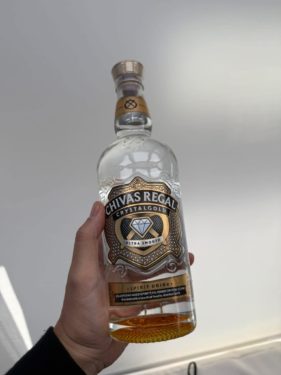
透明なシーバスリーガル

最近は透明な醤油があるとの事ですが、こちらは透明なシーバスリーガル。ちゃんとウイスキーの味がしました。

ただ法律はちょっとややこしい様で裏に色々書いていました。ここの分類はワインソムリエ&エキスパート試験の時に学びましたので、簡単に説明すると

日本の酒税法
→ この製品は「ウイスキー」として分類されます。
そのため、日本向けラベルでは「品目:ウイスキー」と表示する義務があります。

一方、英国(スコットランド)の規制
→ 「Chivas Regal Crystal Gold」は
濾過工程(チルフィルタリングを超えた特殊な透明化処理) により伝統的な“Scotch Whisky”の定義から外れる
ため、「Spirit Drink」
というカテゴリーになります。

つまり、日本ではウイスキー、イギリスではスピリッツ扱いという事の様ですね。


Recently, it seems that even transparent soy sauce is now a thing.
This, however, is a transparent Chivas Regal.
And yes—it did taste properly like whisky.

That said, the legal side is a bit complicated,
as evidenced by the extensive information printed on the back label.

This classification is something I studied for the Wine Sommelier & Expert examination,
so to explain it simply:


Japanese Liquor Tax Law

→ This product is classified as “whisky.”
Accordingly, under Japanese regulations,
the label for the Japanese market is required to state
“Product category: Whisky.”

On the other hand, under UK (Scottish) regulations

“Chivas Regal Crystal Gold”
falls outside the traditional definition of Scotch Whisky
due to its filtration process
(a special clarification treatment beyond standard chill filtration).

As a result, it is categorized as a “Spirit Drink.”


In short,
it is treated as whisky in Japan,
but as a spirit in the United Kingdom.


ゴルフで100切り、90切り、80切りの条件

「ゴルフで100切り・90切り・80切りの条件」。

医科学的・統計学的に眺めると、これは才能論でも感覚論でもなく、極めて再現性の高い条件設定の話になる。

以下は、PGAツアーやアマチュア統計、スポーツ科学論文を横断しながら整理した「現実的な分水嶺」である。

① 100切り(=アマチュア初級卒業ライン)

条件を一言で
「大叩きを消し、ボギーで耐える能力」

定量的条件

OB・池などのペナルティ:18Hで2回以内
ティーショットの前進率:80%以上(距離は問わない)
3パット:18Hで3回以内
パーオン率:10%以下でも可
ダブルボギー以上:3ホール以内

科学的背景

USGAのアマチュア調査では、
スコア100前後の最大の差分因子は「ペナルティ数」であり、ショット精度よりもコースマネジメント欠如が主要因とされている。

この段階では「ナイスショットを増やす」より
ミスの上限を決めることが最短距離だ。

② 90切り(=競技ゴルフへの入口)
条件を一言で
「ボギーをデフォルトにできる技術」

定量的条件
パーオン率:20〜30%
3パット:18Hで1回以内
寄せワン成功率:30%以上
ペナルティ:1ラウンド1回以内
トリプルボギー以上:原則ゼロ

注目すべきポイント
90切りから明確に効いてくるのは
100ヤード以内のスコアメイク能力
PGAツアーではない。

アマチュアにおいては「アプローチ+パット」が全打数の45%以上を占める。

「ドライバーを振り切れるか」ではなく、
「50yを何打で上がれるか」が分水嶺になる。

③ 80切り(=上級者・競技者ゾーン)

条件を一言で
「ダブルボギーを打たない設計思想」

定量的条件
パーオン率:40〜50%
平均パット数:30以下
3パット:ほぼゼロ
寄せワン成功率:50%以上
ボギーオン率(GIR失敗→ボギー):80%以上

スポーツ科学的視点
80台前半のゴルファーでは
ショット分散よりも「ミス後の回復効率」がスコアを決める。

ここでは
感覚 → 再現性
気合 → 確率論
への完全なシフトが起きる。

まとめ:スコア別「思考様式」の違い

スコア帯 ゴルフのテーマ
100切り ミスを減らす
90切り ボギーを取る
80切り ダブルを消す

ゴルフは不思議なスポーツで、上達するほど「攻めなくなる」。そしてスコアは、才能よりも設計思想の精度で決まる。


The Conditions for Breaking 100, 90, and 80 in Golf

When viewed through a medical-scientific and statistical lens,
this is not a discussion about talent or “feel.”
It is a matter of highly reproducible condition setting.

What follows is a set of realistic dividing lines,
organized by cross-referencing PGA Tour data, amateur statistics,
and sports science research.


① Breaking 100

(The Line for Graduating from Beginner-Level Golf)

In one phrase:
The ability to eliminate blow-up holes and survive with bogeys.

Quantitative Conditions

  • Penalties (OB, water hazards): No more than 2 per 18 holes

  • Tee-shot advancement rate: 80% or higher (distance irrelevant)

  • Three-putts: No more than 3 per 18 holes

  • Greens in regulation: Can be as low as 10%

  • Double bogey or worse: Within 3 holes

Scientific Background

According to USGA amateur studies,
the largest differentiating factor around a score of 100
is the number of penalties.

Poor course management—not shot precision—is identified as the primary cause.

At this stage, the shortest path forward is not
“hitting more great shots,”
but clearly defining the upper limit of mistakes.


② Breaking 90

(The Gateway to Competitive Golf)

In one phrase:
The skill to make bogey your default score.

Quantitative Conditions

  • Greens in regulation: 20–30%

  • Three-putts: No more than 1 per 18 holes

  • Up-and-down success rate: 30% or higher

  • Penalties: No more than 1 per round

  • Triple bogey or worse: Essentially zero

Key Insight

What begins to matter decisively when breaking 90
is scoring ability inside 100 yards,
not PGA Tour–level ball striking.

For amateurs, approach shots and putting
account for over 45% of total strokes.

The true dividing line is not
“Can you swing the driver full speed?”
but rather
“How many strokes does it take you to finish from 50 yards?”


③ Breaking 80

(Advanced and Competitive Player Zone)

In one phrase:
A course-design mindset that does not allow double bogeys.

Quantitative Conditions

  • Greens in regulation: 40–50%

  • Average putts per round: Under 30

  • Three-putts: Almost zero

  • Up-and-down success rate: 50% or higher

  • Bogey-on rate
    (missed GIR → bogey): 80% or higher

Sports Science Perspective

Among golfers in the low 80s and below,
scores are determined less by shot dispersion
and more by recovery efficiency after mistakes.

At this level, a complete shift occurs:

  • From feelreproducibility

  • From fighting spiritprobability management


Summary: Differences in “Thinking Style” by Score Level

Score Range Central Theme of Golf
Breaking 100 Reduce mistakes
Breaking 90 Secure bogeys
Breaking 80 Eliminate doubles

Golf is a curious sport:
the better you become, the less you “attack.”

And ultimately,
scores are determined not by talent,
but by the precision of one’s design philosophy.


80切りの正体

80切りの正体
――それは「小脳がゴルフを始めた瞬間」

最近あらためて腑に落ちたことがある。
80を切るゴルフは、もう“考えるゴルフ”ではない。
筋力でも、柔軟性でも、才能でもない。
80切りの本質は、小脳習熟だ。

80切りで何が変わるのか

100切り、90切りまでは、
ゴルフはまだ「前頭葉のスポーツ」だ。
強かった
薄かった
もう少し左だった
すべて言語化できる修正。

しかし80台に入ると、
同じ問いを自分に投げても答えが返ってこない。
「なぜか合っている」

この瞬間、主役は大脳皮質から小脳へ移る。

小脳の仕事とは何か

小脳の本質は
予測誤差の修正(error-based learning)。
「こう振ったら、こうなるはずだ」という内部モデルと
実際の結果との差を、無意識下で自動更新し続ける装置だ。

パターの距離感、
30y以内のアプローチ、
下り1mのタッチ。
ここはもう
考えてはいけない領域になる。
80切りに必要な「小脳領域の技術」

① パッティングの距離感
8〜12mのファーストパットが
必ず50cm以内に止まる。
視覚で合わせているのではない。
予測モデルが完成している。

② 30y以内のアプローチ
芝・傾斜・ライが変わっても、
結果のブレが小さい。
考えた瞬間、距離は狂う。

③ 下り1〜2m
80切りの世界では、
ここは「入れる距離」ではない。
外さない距離だ。
恐怖を抑えるのは意志ではなく、
反射に近い神経制御。

小脳習熟を起こす「練習条件」
80切りに必要なのは、
練習量ではなく条件設定。

条件①:同一課題の反復

同じ距離
同じ振り幅
同じ球質
バリエーションは不要。
まずは固定。

条件②:即時フィードバック
小脳は言葉を理解しない。
結果だけを見る。

条件③:短時間・高頻度
1回20〜30分
週4〜6回
長時間練習は
むしろ逆効果。

週7〜10時間という数字の意味
80切りに必要とされる
週7〜10時間のゴルフ時間。
これは偶然ではない。
小脳が誤差を学習し
睡眠で固定され
次の練習で微修正される

その神経学的サイクルを
回し切る最低限の時間だ。

結論:80切りに必要なゴルフ時間

週7〜10時間
ただし、やみくもに10時間では意味がない。
80切りに到達する人たちは、驚くほど時間の使い方が似ている。

科学的に見た「練習量と到達スコア」
競技ゴルファーと上級アマチュアを対象にした研究では、
ハンディキャップ5以下(≒80切り常態)の層は、
週平均 練習+ラウンド:8.6時間

そのうち 意図的練習(deliberate practice):約70%
という結果が示されている。

重要なのは、
時間よりも「意図を持った反復」である点だ。
80切りゴルファーの「時間配分の実際」

標準モデル(週8〜9時間)

① ラウンド:3.5〜4時間(9H×1 or 18H×隔週)
フルラウンドは必須ではない
9Hで十分「設計思想」は鍛えられる

② パター練習:2〜2.5時間
1m〜2m:反復
8〜12m:距離感
80切りゴルファーの共通点は
3パットが“年間で数えるほど”という点。

③ アプローチ(100y以内):2.5〜3時間
30y以内:転がし・低弾道
50〜80y:振り幅固定
この領域は
スコアへの寄与率が最も高い。

④ フルショット(ドライバー・アイアン):1〜1.5時間
「曲げない」練習のみ
距離アップは不要
80切りの条件は
飛距離ではなく分散管理。

なぜ「週10時間以上」は不要なのか?
運動学習の観点では、週10時間を超えると“質の低下”が起きやすい。

特に中高年アマチュアでは、
神経疲労
判断精度の低下
同じミスの固定化
が生じやすい。

まとめ

80切りとは、才能の証明ではない
飛距離の結果でもない
小脳がゴルフを理解した証拠

そして何より重要なのは、
小脳は年齢に最も優しい学習器官だということ。

正しい条件さえ与えれば、何歳からでも、距離感は突然「合い始める」。
ゴルフは、最後は静かなスポーツになる。


The True Nature of Breaking 80

— The Moment the Cerebellum Starts Playing Golf
A New International Conference Travelogue: Golf Edition

Recently, something finally clicked for me.

Golf that breaks 80 is no longer “thinking golf.”
It’s not about strength, flexibility, or talent.
The essence of breaking 80 lies in cerebellar mastery.


What Changes When You Break 80

Up until breaking 100, then 90,
golf is still a “prefrontal cortex sport.”

Too strong.
Too thin.
Just a little left.

All corrections can be verbalized.

But once you enter the 80s,
you can ask yourself the same questions—
and no answers come back.

“It just somehow feels right.”

At that moment, the main actor shifts
from the cerebral cortex to the cerebellum.


What Does the Cerebellum Do?

At its core, the cerebellum performs
error-based learning.

It continuously and unconsciously updates an internal model—
“If I swing like this, the result should be this”
by correcting the gap between prediction and reality.

Distance control in putting.
Approaches inside 30 yards.
The touch on a 1-meter downhill putt.

These are no longer areas where you are allowed to think.


The “Cerebellar Skills” Required to Break 80

① Putting Distance Control

First putts from 8–12 meters
always stop within 50 cm.

You are not matching distance visually.
The predictive model is already complete.

② Approaches Inside 30 Yards

Even when the grass, slope, or lie changes,
the dispersion of results stays small.

The moment you think,
distance control collapses.

③ Downhill Putts of 1–2 Meters

In the world of breaking 80,
this is not a distance to “make.”
It is a distance you do not miss.

Suppressing fear is not about willpower,
but about near-reflexive neural control.


Practice Conditions That Trigger Cerebellar Mastery

What’s required to break 80
is not volume, but conditions.

Condition ①: Repetition of the Same Task

Same distance.
Same swing length.
Same ball flight.

No variations needed.
Fix it first.

Condition ②: Immediate Feedback

The cerebellum does not understand words.
It only observes results.

Condition ③: Short Duration, High Frequency

20–30 minutes per session.
4–6 times per week.

Long practice sessions
are actually counterproductive.


The Meaning of “7–10 Hours per Week”

The often-cited requirement of
7–10 hours of golf per week to break 80
is no coincidence.

It is the minimum time needed to fully cycle through
the neurological loop:

Error learning by the cerebellum →
consolidation during sleep →
fine adjustment in the next practice.


Conclusion: The Golf Time Required to Break 80

7–10 hours per week.
But blindly spending 10 hours has no meaning.

Those who reach breaking 80
use their time in remarkably similar ways.


Practice Time and Achieved Scores: A Scientific View

Studies of competitive golfers and advanced amateurs show that
players with handicaps of 5 or lower
(roughly consistent breaking 80) average:

8.6 hours per week (practice + rounds)

Of that, about 70% is
deliberate practice.

What matters is not time itself,
but repetition with intent.


How Breaking-80 Golfers Actually Allocate Their Time

Standard Model (8–9 hours per week)

① Rounds: 3.5–4 hours
(9 holes once a week, or 18 holes every other week)
A full round is not essential.
Nine holes are sufficient to train course strategy.

② Putting Practice: 2–2.5 hours
1–2 m: repetition
8–12 m: distance control

A common trait of breaking-80 golfers:
three-putts are “countable on one hand per year.”

③ Approach Shots (Inside 100y): 2.5–3 hours
Inside 30y: bump-and-run, low trajectory
50–80y: fixed swing length

This zone has the highest contribution to scoring.

④ Full Shots (Driver & Irons): 1–1.5 hours
Practice only to “not curve.”
No need for added distance.

Breaking 80 is about dispersion management,
not power.


Why More Than 10 Hours per Week Is Unnecessary

From a motor-learning perspective,
practice beyond 10 hours per week
often leads to a decline in quality.

Especially for middle-aged and senior amateurs:

  • neural fatigue

  • reduced decision accuracy

  • fixation of recurring mistakes

are more likely to occur.


Summary

Breaking 80 is not proof of talent.
It is not the result of distance.

It is evidence that
the cerebellum has understood golf.

Most importantly,
the cerebellum is the most age-friendly learning organ we have.

Given the right conditions,
distance control can suddenly “click” at any age.

In the end,
golf becomes a quiet sport.


真珠の耳飾りの少女の皮膚科泌尿器科的な解釈

「真珠の耳飾りの少女」の皮膚科泌尿器科的な解釈

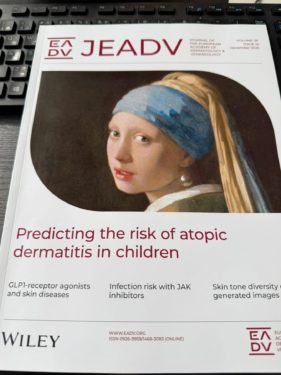
クリニックFに今月のEADV(欧州皮膚科泌尿器科学会)学会誌が届きました。いつもは病気の写真などが多いのですが、ハッと目を惹くフェルメールの絵画が表紙だったのです。

もう10年ほど前ですが、僕は世界に散らばる40枚弱のフェルメールの絵画を現地の美術館で観ることを趣味にしていた時期があって、個人所有のもの以外は全て現地で観てきました。

マウリッツハイスにあるこの絵も「青いターバンの少女」との別名があります。フェルメールは青を作るのにラピスラズリという高価な鉱石を使っていましたので、とにかく美しい青に惹かれて現地を見て回ったのを思い出します。ただ、実際に対峙して観ると圧倒的に真珠の耳飾りの印象が強いのです。

記事内容の文章ですが、ちょっと興味深かったので読んでもらおうと翻訳しました。

以下翻訳

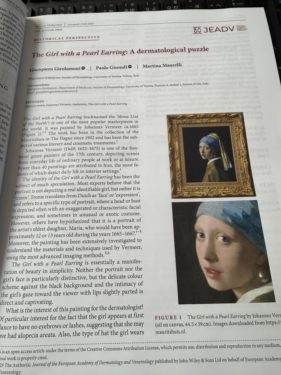
『真珠の耳飾りの少女』(通称「北のモナ・リザ」)は、世界で最も人気のある名画の一つである。本作はヨハネス・フェルメールによって1665年頃に描かれた(図1)。1902年以来、オランダ・ハーグのマウリッツハイス美術館の所蔵となっており、これまで数多くの文学作品や映画の題材となってきた。

ヨハネス・フェルメール(1632年デルフト生まれ、1675年没)は、17世紀を代表する風俗画家の一人であり、日常生活の中で働く人々や憩う人々の姿を描いた作品で知られている。彼の作品として現存し、真作と認められている絵画は40点未満で、その多くは室内空間における日常生活の場面を描いたものである。

『真珠の耳飾りの少女』に描かれた少女の正体については、長年にわたり多くの議論がなされてきた。多くの専門家は、この作品が特定の実在人物を描いた肖像画ではなく、「トローニー(tronie)」であると考えている。

トローニーとはオランダ語で「顔」あるいは「表情」を意味し、誇張された、あるいは特徴的な表情を持つ頭部または胸像を描く特定の肖像形式を指す。しばしば、珍しい、あるいは異国風の衣装が用いられるのも特徴である。

一方で、この少女はフェルメールの長女マリアであり、制作当時の1665〜1667年頃には12〜13歳であったのではないかとする仮説も提唱されている。

さらに本作は、フェルメールが用いた画材や技法を解明する目的で、最先端の画像解析技術を用いた詳細な調査が行われてきた。

『真珠の耳飾りの少女』は、本質的には「単純さの中にある美」の顕現である。肖像そのものも、少女の顔立ちも決して特異ではないが、黒い背景に対する繊細な色彩設計、わずかに開かれた唇とともに鑑賞者をまっすぐに見つめる視線の親密さは、直接的で見る者を強く惹きつける。

では、この絵画は皮膚科医にとってどのような関心を呼び起こすのだろうか。

特に注目すべき点は、少女が一見すると眉毛やまつ毛を欠いているように見えることであり、円形脱毛症を患っていた可能性が示唆される点である。また、この時代としては異例とも言える見事なターバンは、異国趣味を表現するためというより、頭皮の脱毛(円形脱毛症など)を隠す目的で着用されていた可能性がある。

さらに、肉眼的X線蛍光分析(macroscopic X-ray fluorescence scanning)によって、まつ毛が非常に疎であることが明らかになっており、彼女は眉毛やまつ毛の脱落を意味する「眉毛脱落症(madarosis)」を有していた可能性が示唆される。

眉毛脱落症にはさまざまな原因があり、炎症性(前頭線維性脱毛症)、感染性(梅毒)、腫瘍性(T細胞リンパ腫)、代謝性(甲状腺機能低下症)、あるいは遺伝性(毛包性角化症を伴う瘢痕性脱毛症:keratosis follicularis spinulosa decalvans)などが挙げられる。

しかし、紅斑やその他の皮膚所見が認められないこと、また少女の年齢を考慮すると、最も可能性が高いのは円形脱毛症であると考えられる。

梅毒の可能性については以前から指摘されてきた。下唇左側には小さな赤い部位があり、びらんのように見えるため、第一期梅毒における初期硬結(初期下疳)ではないかと疑われたこともある。

しかし、脱毛は梅毒の第二期にみられる症状であり、唇の赤い部位は口唇ヘルペス、あるいは外傷によるものかもしれない。

また、ヨウ素欠乏が多い地域とは異なり、17世紀のオランダでは甲状腺腫は比較的まれであった。

いずれにせよ、医学的な考察の有無にかかわらず、この絵画、そしてこの少女が持つ魅力が損なわれることはない。
私たちはここに、「理想化された美」の一つの姿を見ているのである。


A Dermatological and Urological Interpretation of Girl with a Pearl Earring

The latest issue of the EADV (European Academy of Dermatology and Venereology) journal arrived at Clinic F this month. Usually, the cover features numerous photographs of diseases, but this time my eye was suddenly caught by a painting by Vermeer.

About ten years ago, I went through a period when I made it a hobby to visit museums around the world to see the fewer than forty Vermeer paintings scattered across the globe. With the exception of those in private collections, I managed to view all of them in person.

This painting, housed in the Mauritshuis, is also known by the alternative title Girl with a Blue Turban. Vermeer famously used lapis lazuli—an extremely expensive mineral—to create blue pigment, and I vividly recall traveling to see these works in person, drawn by their extraordinary blue tones. However, when standing face to face with this painting, the overwhelming impression is undeniably that of the pearl earring.

The article itself was quite intriguing, so I translated it for readers to enjoy.


Translation

Girl with a Pearl Earring (often referred to as the “Mona Lisa of the North”) is one of the most beloved masterpieces in the world. The painting was created around 1665 by Johannes Vermeer (Figure 1). Since 1902, it has been part of the collection of the Mauritshuis in The Hague, the Netherlands, and has inspired numerous literary works and films.

Johannes Vermeer (born in Delft in 1632, died in 1675) was one of the leading genre painters of the 17th century, renowned for his depictions of people working or resting in scenes of everyday life. Fewer than forty paintings are currently accepted as authentic works by Vermeer, and many of them portray daily life within interior spaces.

The true identity of the girl depicted in Girl with a Pearl Earring has long been the subject of debate. Many experts believe that the work is not a portrait of a specific individual, but rather a tronie.

The term tronie comes from Dutch, meaning “face” or “expression,” and refers to a specific type of portrait depicting a head or bust with exaggerated or distinctive facial expressions. Such works often feature unusual or exotic costumes.

On the other hand, a hypothesis has also been proposed that the girl may have been Vermeer’s eldest daughter, Maria, who would have been approximately 12 or 13 years old at the time the painting was created, around 1665–1667.

In addition, the painting has been subjected to extensive investigation using state-of-the-art imaging technologies in order to elucidate the materials and techniques employed by Vermeer.

At its core, Girl with a Pearl Earring represents a manifestation of “beauty in simplicity.” Neither the portrait itself nor the girl’s facial features are particularly extraordinary. However, the delicate use of color against the dark background, combined with the intimacy of her direct gaze and slightly parted lips, exerts an immediate and powerful attraction on the viewer.

What, then, might this painting evoke in the mind of a dermatologist?

One particularly noteworthy feature is that the girl appears, at first glance, to lack eyebrows and eyelashes, suggesting the possibility that she may have suffered from alopecia areata. Moreover, the striking turban—unusual for the period—may have been worn not merely to convey an exotic aesthetic, but to conceal scalp hair loss, such as that caused by alopecia areata.

Furthermore, macroscopic X-ray fluorescence scanning has revealed that the eyelashes are extremely sparse, suggesting that she may have had madarosis, a condition characterized by the loss of eyebrows and eyelashes.

Madarosis can result from a variety of causes, including inflammatory conditions (such as frontal fibrosing alopecia), infectious diseases (such as syphilis), neoplastic disorders (such as T-cell lymphoma), metabolic conditions (such as hypothyroidism), or hereditary diseases (such as keratosis follicularis spinulosa decalvans, a form of scarring alopecia associated with follicular hyperkeratosis).

However, given the absence of erythema or other notable skin findings, and considering the girl’s young age, alopecia areata appears to be the most plausible diagnosis.

The possibility of syphilis has also been discussed in the past. A small reddish area on the left side of the lower lip resembles an erosion and has been suspected to represent a primary chancre of primary syphilis.


Nevertheless, hair loss typically occurs during secondary syphilis, and the reddish lesion on the lip may instead represent herpes labialis or a traumatic injury.

Additionally, unlike regions where iodine deficiency was common, goiter was relatively rare in 17th-century Netherlands.

In any case, regardless of whether such medical interpretations are valid, the charm of this painting—and of the girl herself—remains entirely undiminished. What we see here is one manifestation of “idealized beauty.”


老化は微小炎症の積み重ね

微小炎症(micro-inflammation)とは何か、そしてどうして起こるのか

「炎症」と聞くと、多くの人は
赤く腫れて、熱をもち、痛みを伴う――
そんな“わかりやすい異常”を思い浮かべる。

だが老化の現場で問題になる炎症は、
本人がまったく気づかない炎症だ。

微小炎症とは何か
微小炎症(chronic low-grade inflammation)とは、
自覚症状をほとんど伴わず、低レベルの炎症反応が何年も持続している状態を指す。

血液検査をしても、

CRPは「基準値内」
白血球数も「正常」
発熱も痛みもない

それでも体内では、
IL-6、TNF-α、IL-1βといった

炎症性サイトカインが常時うっすら出続けている。
これを老化研究の世界では
Inflammaging(炎症性老化)と呼ぶ。

なぜ「微小」なのに問題なのか

理由は単純だ。
炎症は本来、短期間で終わる前提の修復スイッチだから。

それが常時オンになると、

修復細胞が疲弊する
ミトコンドリアが消耗する
幹細胞が枯れていく
結果として、
老化・変性・回復力低下が進む。

微小炎症は「どうしたら」起こるのか
重要なのはここだ。
微小炎症は、特別な病気がなくても日常で簡単に起こる。

① 内臓脂肪が増える
脂肪組織は、
単なるエネルギー倉庫ではない。
内臓脂肪は、

IL-6
TNF-α
を分泌する炎症臓器になる。

「太っていないのに老ける」人の多くは、
皮下脂肪ではなく内臓脂肪型だ。

② 血糖スパイクを繰り返す

血糖が急上昇・急降下すると、
酸化ストレス↑
AGE産生↑
炎症性サイトカイン↑
が同時に起こる。
これが毎日起これば、
炎症は“消える暇”がない。

③ 睡眠不足・概日リズムの破綻

睡眠は、炎症を終わらせる時間でもある。
睡眠不足が続くと、

コルチゾール上昇
免疫制御破綻
炎症性サイトカイン持続

④ 精神的ストレスが慢性化する

ストレスは心の問題ではない。
免疫の問題だ。
HPA軸が慢性的に刺激されると、

免疫のブレーキが壊れる
炎症が「止まらなくなる」

⑤ 運動不足、あるいはやりすぎ

適度な運動は抗炎症。
だが、
まったく動かない
回復を無視して追い込む
どちらも微小炎症を生む。

重要な誤解
微小炎症は
「年を取ったから起こる」のではない
起こし続けた結果、年を取る

これが順序だ。

まとめ

微小炎症とは何か

自覚症状のない
低レベルで
終わらない炎症

どうしたら起こるか

内臓脂肪
血糖スパイク
睡眠不足
慢性ストレス
運動バランスの破綻

アンチエイジングとは、これを「特別な治療」で止めることではない。微小炎症を生まない生活設計を淡々と続けることだ。

老化は、ある日突然起こる事件ではない。
毎日、静かに許してしまった炎症の積み重ねなのだ。


What Is Micro-Inflammation, and Why Does It Occur?

When people hear the word “inflammation,”
many imagine something obvious:

Redness, swelling, heat, and pain—
a clear and noticeable abnormality.

However, the inflammation that becomes problematic in the context of aging
is one that the person does not notice at all.

What Is Micro-Inflammation?

Micro-inflammation, also known as chronic low-grade inflammation,
refers to a state in which low-level inflammatory responses persist for years
with little to no subjective symptoms.

Even when blood tests show:

  • CRP within the “normal range”

  • White blood cell count “normal”

  • No fever or pain

Inside the body, inflammatory cytokines such as:

  • IL-6

  • TNF-α

  • IL-1β

continue to be released at low levels at all times.

In the field of aging research, this phenomenon is called
inflammaging—inflammatory aging.


Why Is It a Problem If It’s “Micro”?

The reason is simple.

Inflammation is originally designed as a short-term repair switch.
When that switch remains constantly on:

  • Repair cells become exhausted

  • Mitochondria are depleted

  • Stem cells gradually decline

As a result, aging, degeneration, and reduced recovery capacity accelerate.


How Does Micro-Inflammation Occur?

This is the key point.

Micro-inflammation can easily arise in everyday life,
even without any specific disease.

1. Increase in Visceral Fat

Fat tissue is not merely an energy storage site.
Visceral fat, in particular, becomes an inflammatory organ that secretes:

  • IL-6

  • TNF-α

Many people who “age despite not appearing overweight”
actually have excess visceral fat rather than subcutaneous fat.

2. Repeated Blood Sugar Spikes

When blood glucose rapidly rises and falls:

  • Oxidative stress increases

  • AGE production increases

  • Inflammatory cytokines increase

If this happens daily, inflammation never has a chance to subside.

3. Sleep Deprivation and Circadian Rhythm Disruption

Sleep is also the time when inflammation is resolved.
Chronic sleep deprivation leads to:

  • Elevated cortisol

  • Breakdown of immune regulation

  • Persistent inflammatory cytokine release

4. Chronic Psychological Stress

Stress is not merely a mental issue—it is an immune issue.
When the HPA axis is chronically activated:

  • The immune “brake” breaks down

  • Inflammation becomes unstoppable

5. Too Little—or Too Much—Exercise

Moderate exercise is anti-inflammatory.
However:

  • Complete inactivity

  • Excessive training without recovery

Both can trigger micro-inflammation.


A Critical Misconception

Micro-inflammation does not occur because we age.
Rather, we age because micro-inflammation continues.

This is the correct order.


Summary

What is micro-inflammation?

  • Symptom-free

  • Low-level

  • Never-ending inflammation

How does it occur?

  • Visceral fat

  • Blood sugar spikes

  • Sleep deprivation

  • Chronic stress

  • Imbalanced exercise habits

Anti-aging is not about stopping this with “special treatments.”
It is about consistently designing a lifestyle that does not generate micro-inflammation.

Aging is not a sudden event that happens one day.
It is the accumulation of inflammation that we quietly allow—every single day.


カテゴリー