














本日は診療前に、三菱商事ライフサイエンスグループとの新たな共同研究実験でした。
集中してレーザーを照射する事15名。NMNとレーザーの相乗効果を検証しようと思っています。
NMN とレーザー —— 作用機序に見られる「意外な共通点」
NMN(Nicotinamide Mononucleotide)と低出力レーザー(Photobiomodulation, PBM)。
一見まったく別物に見えるこの二つですが、細胞レベルまで降りていくと、驚くほど似た振る舞いをしていることがわかってきます。
1. 共通の舞台は「ミトコンドリア」
NMNもレーザーも、最終的に狙っている主戦場はミトコンドリアです。
NMN
→ NAD⁺の前駆体として細胞内に取り込まれ、電子伝達系・
TCA回路を通じてATP産生を底上げする。
レーザー(PBM)
→ 主にミトコンドリア内膜に存在するシトクロムcオキシダーゼ(Complex IV)が光を吸収し、電子伝達効率が向上する。
つまり両者とも、「エネルギー通貨ATPを増やす」方向に働く点で一致しています。
2. NAD⁺と電子伝達系 —— 同じ回路を別方向から叩く
もう一段深く見ると、電子の流れという共通キーワードが浮かび上がります。
NMN → NAD⁺増加 → NADH供給増加 → Complex I から電子供給
レーザー → Complex IV 活性化 → 電子の“出口”が広がる
入口(NMN)と出口(レーザー)は違っても、同じ電子伝達系という川の流れを太くしているわけです。
つまり
「NMNは燃料、レーザーはタービン調整」
という役割です。
3. ROSは敵か味方か —— シグナルとしての共通利用
興味深いのは、どちらもROS(活性酸素)を完全には消さない点です。
NMN:代謝活性化に伴い軽度のROS増加
レーザー:一過性のROS上昇をシグナルとして利用
この「軽い酸化ストレス」は、
NRF2
SIRT1
PGC-1α
といった細胞防御・ミトコンドリア新生経路を活性化します。
完全にROSをゼロにするのではなく、使いこなすという思想が共通しています。
4. 「直接治療」ではなく「環境改善」
NMNもレーザーも、抗生物質や手術のように直接何かを除去する治療ではありません。
細胞が本来持っている
回復力
適応力
エネルギー産生能力
を引き出す医療である点が、本質的に同じです。
だからこそ、効きすぎない 効かなさすぎない
使い方で結果が変わる
という、いかにも「調律型医療」らしい特徴を持ちます。
まとめ 異なる入口、同じ出口
NMNとレーザーの共通点を一言で言えば、
「ミトコンドリアの時間を若返らせる介入」
です。
分子(NMN)と光(レーザー)。
アプローチは違っても、細胞が向かう先は同じ。
国際学会を巡っていて、これほど美しい収束を見る瞬間は、そう多くありません。
次に考えるべきテーマは、「併用は相加か、相乗か」です。こうご期待。
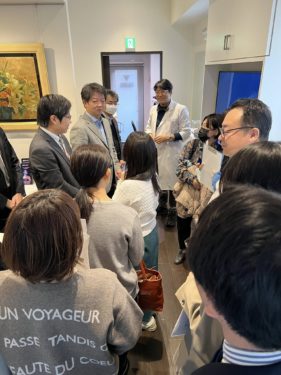

Today, prior to clinical consultations, we conducted a new collaborative experimental study with the Mitsubishi Corporation Life Sciences Group.
Fifteen participants underwent focused laser irradiation, and we aim to investigate the synergistic effects of NMN and laser therapy.
NMN and Laser Therapy — An Unexpected Convergence in Mechanism of Action
NMN (Nicotinamide Mononucleotide) and low-level laser therapy, or photobiomodulation (PBM).
At first glance, these two interventions appear entirely unrelated.
However, when we descend to the cellular level, it becomes clear that they exhibit remarkably similar behaviors.
1. A Shared Battlefield: The Mitochondria
Both NMN and laser therapy ultimately target the mitochondria as their primary site of action.
NMN
→ Taken up into cells as a precursor of NAD⁺, enhancing ATP production via the electron transport chain and the TCA cycle.
Laser (PBM)
→ Light is absorbed primarily by cytochrome c oxidase (Complex IV) in the inner mitochondrial membrane, improving the efficiency of electron transport.
In short, both interventions converge on the same goal: increasing the production of ATP, the cell’s energy currency.
2. NAD⁺ and the Electron Transport Chain — Targeting the Same Pathway from Different Directions
Looking one level deeper, the common keyword that emerges is electron flow.
NMN → increased NAD⁺ → increased NADH supply → enhanced electron input at Complex I
Laser → activation of Complex IV → expansion of the electron “exit”
Although the entry point (NMN) and the exit point (laser) differ, both effectively widen the same river—the electron transport chain.
In this sense:
“NMN supplies the fuel, while the laser fine-tunes the turbine.”
3. ROS: Enemy or Ally? — A Shared Use as a Signaling Molecule
Another intriguing similarity is that neither intervention seeks to eliminate reactive oxygen species (ROS) entirely.
NMN: mild ROS increase accompanying metabolic activation
Laser: transient ROS elevation utilized as a signaling trigger
This “mild oxidative stress” activates key cytoprotective and mitochondrial biogenesis pathways, including:
NRF2
SIRT1
PGC-1α
Rather than reducing ROS to zero, both approaches share the philosophy of harnessing ROS appropriately.
4. Not “Direct Treatment,” but “Environmental Optimization”
Neither NMN nor laser therapy removes pathogens or tissues directly, as antibiotics or surgery do.
Instead, both aim to draw out the cell’s inherent capacities for:
recovery
adaptation
energy production
This fundamental similarity places them squarely within what might be called “tuning-based medicine.”
As a result, outcomes depend critically on dosage and application—
neither too strong, nor too weak—
a hallmark of regulatory rather than destructive interventions.
Conclusion: Different Entrances, the Same Exit
If the commonality between NMN and laser therapy were to be summarized in a single phrase, it would be this:
“An intervention that rejuvenates mitochondrial time.”
One is a molecule; the other, light.
The approaches differ, but the destination of the cell is the same.
Having traveled across international scientific conferences, I can say that moments of such elegant convergence are rare.
The next question to be addressed is clear:
Is their combined use merely additive—or truly synergistic?
Stay tuned.