契約の文明:文明の系譜図:カナンから地中海文明へ
ーーフェニキア・イスラエル・カルタゴ・日本、四つの約束ーー
Ⅰ. カナンの双子:海と砂漠の兄弟文明
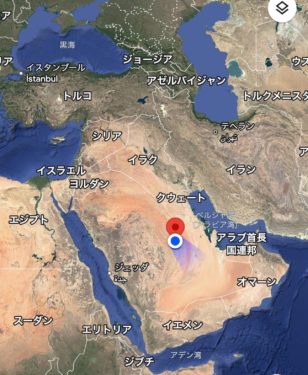
地中海の東岸、レバノンからイスラエルにかけての細長い地帯――古代カナン。
ここから二つの兄弟文明が生まれた。
北に海を抱くフェニキア。
南に砂漠を抱くイスラエル。
同じカナン語を話し、同じ神々を祀りながら、
一方は「海の契約」を、もう一方は「神の契約」を発明した。
フェニキア人は港を神殿のように設計し、
イスラエル人は神殿を契約の象徴として築いた。
宗教と経済をつなぐ“信義の文明”――
その原点がカナンにあった。
Ⅱ. フェニキア人:海を渡る契約の民
フェニキア人は、海と契約の民であった。
彼らにとって取引とは単なる商行為ではなく、
「契約(b’rt)」=誓い=神への責務であった。
この語源は、イスラエルの「契約(berith)」と同根である。
彼らは信義を刻むために文字を生み出し、
その表記体系はやがてアルファベットとして世界に広がった。
――“書くこと”は、“信頼を記す”ことだったのだ。
ティルの王ヒラムがソロモン王にレバノン杉を送り、
エルサレム神殿の建築を助けたとき、
そこに生まれたのは単なる貿易ではなく、文明の契約だった。
「ヒラムはソロモンの求めに応じ、レバノンの杉を与えた。」
— 『列王記上』5章6節
フェニキア人は信義の技術者であり、
その精神はのちに海上商業の倫理として受け継がれる。
Ⅲ. 西へ:カルタゴ、海上の契約国家
フェニキア人が地中海を渡り、北アフリカのチュニスの地に築いた都市――それがカルタゴ(Carthago, “新しい都市”)である。
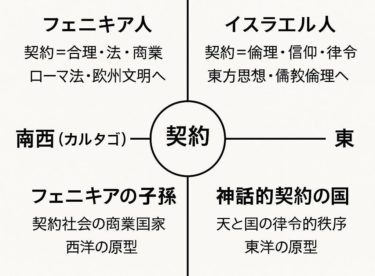
カルタゴはフェニキア文明の西方的進化形であり、契約の精神を制度化した国家だった。
カルタゴの港湾は二重構造を持ち、
軍港と商港を分け、全てが法的契約で運営された。
その構造には、すでにローマ法の萌芽が見られる。
カルタゴ人にとって「信頼」とは宗教的価値であり、
商業とは神と人との約束の延長であった。
彼らは地中海世界に“契約社会の原型”を築いたのである。
フェニキア→カルタゴの系譜は、
“契約の合理化”という形で西洋へと受け継がれた。
それはローマ法、商事法、契約自由の原理へと変容してゆく。
Ⅳ. イスラエル:砂漠に生まれた倫理の契約
一方、砂漠の民イスラエルは、
神との契約(berith)を文明の中心に据えた。
十戒は宗教儀礼ではなく、共同体の社会契約であり、
神の法による合意社会の最初のモデルであった。
預言者たちは契約が歪められるたびにその倫理を正し、
「正義と義」を共同体の羅針盤とした。
宗教を超えて倫理を基軸にする――
それがイスラエル文明の真骨頂である。
Ⅴ. 契約の内面化:ディアスポラが生んだ知恵
バビロン捕囚ののち、イスラエル人は世界に離散した。
だが彼らは「契約を記憶する民族」として生き残った。
神殿を失っても、律法(トーラー)があれば共同体は維持できた。
契約は制度から内面へ、形式から理念へと変化した。
血縁ではなく理念でつながる共同体――
そこに、近代的「信義社会」の萌芽があった。
Ⅵ. 東へ:日本、沈黙の契約国家
そして東の果てに辿り着くもうひとつの契約文明――日本。
「天の誓約(うけい)」や「盟神探湯(くかたち)」は、
神々の真実を試す契約儀礼であり、
イスラエルの契約思想と驚くほど響き合う。
イスラエルが“言葉による契約”で社会を保ったのに対し、
日本は“沈黙による契約”で秩序を維持した。
書かれた律法の代わりに、和と空気がそれを担った。
それでも根底にあるのは同じ――
誠(makoto)=信義の倫理である。
Ⅶ. 山本七平『日本人とユダヤ人』:沈黙と契約の比較文明
1970年、山本七平は「イザヤ・ベンダサン」というユダヤ名で『日本人とユダヤ人』を著した。
外交官を志していた高校時代の僕は、
父の本棚からその一冊を取り出して繰り返し読んだ記憶がある。
宗教ではなく社会構造の比較として、“無宗教の日本人も契約倫理を共有している”という洞察に、強く心を打たれた。
「日本人は神を信じないが、空気を信じる。
ユダヤ人は神を信じるが、空気を信じない。」
ユダヤ社会では“契約”が秩序を生み、
日本社会では“空気(無言の合意)”が秩序を保つ。
形式は違えど、どちらも「信義を中核とする文明」である。
山本の直観は、
古代カナンに始まる“契約的精神の遺伝子”を見抜いていた。
畢竟、四つの文明はそれぞれ、
異なる形で“信義を制度化する”ことに成功した。
それが文明を持続させた共通の力――契約の哲学である。
Ⅸ. 結語:契約の星空の下で
フェニキアの船乗りも、イスラエルの預言者も、
カルタゴの商人も、日本の祭司も――
同じ星空を見上げていた。
その星は、信義という普遍の光。
海の契約、神の契約、法の契約、天の契約。
四つの文明がそれぞれの方角で、
人間が「信頼」を形にする方法を模索した。
文明とは、神話ではなく信頼の形式である。
そして誠実とは、最古にして最も普遍的な契約の言葉なのだ。
あとがき
フェニキアが「文字で契約を記した」文明なら、
イスラエルは「言葉で契約を語った」文明、
カルタゴは「法で契約を管理した」文明、
日本は「沈黙で契約を守った」文明である。
――その四つの文明が描くのは、
人類が“信頼”を軸に構築してきた契約の銀河図。
文明の核心とは、信仰でも技術でもなく、
「誠実であろうとする意思」なのかもしれない。
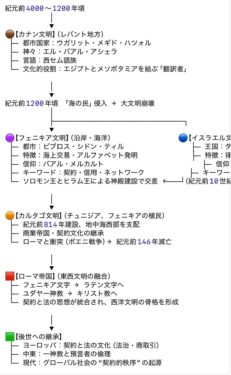
The Civilizations of the Covenant: A Genealogy of Civilizations – From Canaan to the Mediterranean World
Phoenicia, Israel, Carthage, Japan — Four Promises
I. The Twins of Canaan: Brother Civilizations of Sea and Desert
On the eastern shore of the Mediterranean — a narrow strip stretching from Lebanon to Israel — once lay ancient Canaan.
From this land, two sibling civilizations emerged:
Phoenicia, cradled by the sea to the north;
Israel, embraced by the desert to the south.
They spoke the same Canaanite language and worshipped the same gods.
Yet one gave rise to the “Covenant of the Sea”, the other to the “Covenant with God.”
The Phoenicians designed their harbors as if they were temples.
The Israelites built their temple as a symbol of covenant.
A “civilization of faith and trust” — linking religion and commerce —
had its origin in Canaan.
II. The Phoenicians: A Seafaring People of Covenant
The Phoenicians were a people of the sea and of covenants.
To them, a transaction was not merely commerce —
it was a “b’rt” — an oath, a responsibility to the divine.
This word shares its root with the Hebrew “berith” — also meaning “covenant.”
In order to record their pledges, they invented writing.
Their script would later evolve into the alphabet we use today.
To write was to record trust.
When King Hiram of Tyre sent cedars of Lebanon to King Solomon
to help build the Temple in Jerusalem,
what was born was more than trade — it was a covenant of civilization.
“Hiram gave Solomon all the cedar and cypress timber he desired.”
— 1 Kings 5:10
The Phoenicians were engineers of faith,
and their spirit lived on in the ethics of maritime commerce.
III. Westward: Carthage, a Maritime Covenant-State
Crossing the Mediterranean, the Phoenicians built a city on the shores of North Africa — Carthage (meaning “New City”).
Carthage was a western evolution of Phoenician civilization,
a state where the spirit of covenant was institutionalized.
Its harbor had a dual structure:
one for military, one for commerce — both governed by legal contracts.
In this system, we see early traces of Roman law.
To the Carthaginians, “trust” was a sacred value.
Commerce was an extension of the promises made between gods and humans.
They laid the foundation of a “covenantal society” across the Mediterranean world.
The lineage from Phoenicia to Carthage was passed on to the West
as the rationalization of covenant —
transforming into Roman law, commercial codes, and the principle of freedom of contract.
IV. Israel: An Ethical Covenant Born of the Desert
Meanwhile, the desert people of Israel placed their covenant with God — berith — at the heart of civilization.
The Ten Commandments were not mere religious rites,
but a social contract for the community —
an early model of a society bound by divine law.
Each time the covenant was distorted, the prophets restored its ethics,
making “justice and righteousness” the compass of their community.
To base society not just on religion, but on ethics —
that was the core spirit of the Israelite civilization.
V. Internalizing the Covenant: Wisdom Born of Diaspora
After the Babylonian exile, the Israelites were scattered across the world.
Yet they survived as a people who remembered the covenant.
Even without the Temple, the Torah sustained their communities.
Covenant shifted from system to interiority, from form to principle.
A community bound not by blood, but by shared ideals —
this was the seed of the modern “society of trust.”
VI. Eastward: Japan, a Silent Covenant Civilization
At the far eastern end of the world lies another covenantal civilization: Japan.
Rituals such as the “Oath of Heaven” (ukei) and the “Trial by boiling water” (kugatachi)
were ceremonies to test divine truth —
remarkably resonant with Israel’s covenantal worldview.
While Israel maintained society through covenants of words,
Japan upheld order through covenants of silence.
Instead of written law, harmony and atmosphere played that role.
Yet the underlying principle is the same:
Makoto — sincerity — the ethics of trust.
VII. Shichihei Yamamoto’s The Japanese and the Jews: A Comparative Civilization of Silence and Covenant
In 1970, Shichihei Yamamoto, under the Jewish pseudonym Isaiah Ben-Dasan, published The Japanese and the Jews.
As a high school student dreaming of diplomacy,
I remember repeatedly reading the book from my father’s shelf.
His insight struck me deeply:
as a comparison of social structures, not religions —
that even non-religious Japanese share a covenantal ethic.
“The Japanese don’t believe in God, but they believe in atmosphere.
The Jews believe in God, but not in atmosphere.”
In Jewish society, covenant creates order.
In Japanese society, atmosphere (silent consensus) preserves it.
Different in form, yet both are civilizations centered on trust.
Yamamoto’s intuition perceived the genetic spirit of covenant
that began in ancient Canaan.
Ultimately, these four civilizations each succeeded in institutionalizing trust in distinct ways.
That shared force — the philosophy of covenant — sustained their civilizations.
IX. Conclusion: Beneath the Starry Sky of Covenant
Phoenician sailors, Israelite prophets, Carthaginian merchants, Japanese priests —
they all looked up at the same starry sky.
And those stars shone with the universal light of trust.
A covenant of the sea, a covenant with God, a legal covenant, a heavenly covenant.
Each civilization, from its own direction,
searched for a way to give form to human trust.
Civilization is not a myth —
it is a structure of trust.
And sincerity is the oldest, most universal word of covenant.
Postscript
If Phoenicia was a civilization that wrote its covenants,
Israel was one that spoke them,
Carthage regulated them by law,
and Japan upheld them in silence.
Together, these four civilizations depict
a galactic map of humanity’s pursuit of trust through covenant.
At its core, civilization is neither faith nor technology —
but the will to be sincere.