














Vincent ゴッホという名の署名――
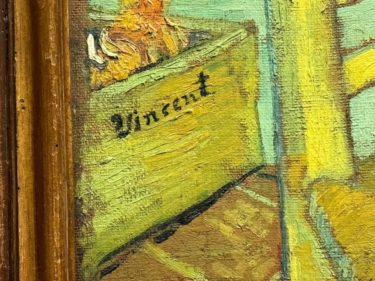
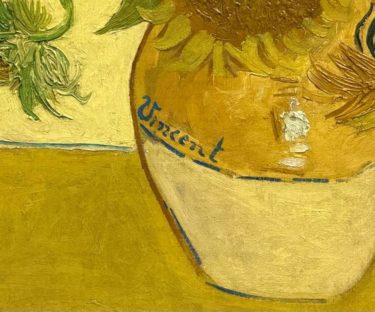
ロンドンのナショナル・ギャラリーで『ひまわり』を見つめていると、右下に赤く光るひとつのサインが目に入る。
“Vincent.”
たったそれだけ。
姓も称号もいらない。そこに在るのは、彼自身の存在そのものだ。
ゴッホは、いまや世界最高の画家の一人と称されながら、生前に売れた絵はたった一枚――1888年の《赤い葡萄畑》(Anna Bochが400フランで購入)。
彼がキャンバスに記した「Vincent」というサインには、姓ではなく“魂の名”として生きた芸術家自身の存在を刻もうとした意思があった。
孤独の中で絵筆を握り、死後に世界がその光に気づいた。
Ⅰ 家名を捨てた芸術家
ゴッホが「van Gogh」ではなく「Vincent」とサインしたのは、単なる発音の問題ではない。
彼は1882年の手紙でこう書いている。
“I want to sign simply ‘Vincent’ — because the people here have trouble pronouncing Van Gogh.”
「ただ『Vincent』とサインしたいんだ。ここの人たちは『ファン・ゴッホ』を発音しづらいからね。」
しかし、その裏にはもっと深い意味がある。
家名“van Gogh”は、商人の血、牧師の家系、そして社会に適応できなかった自分を常に縛る「過去」だった。
名だけを残したのは、「家」ではなく「個」として生きる」宣言である。
芸術の世界で生きるには、社会の系譜から自由でなければならない――
彼はそれを“Vincent”というたった七文字に託したのだ。
Ⅱ 観る者への呼びかけ
もうひとつの理由は、「他者との対話」である。
絵の中の“Vincent”は、観る者に語りかけている。
孤独の中で描かれた作品たちは、彼にとって「話し相手」そのものだった。
だからこそ、サインは自分の名を告げる挨拶のように、画面の片隅に置かれた。
“I, Vincent, am here with you.”
「私はここにいる、あなたと共に。」
『夜のカフェテラス』(1888)の右下の黄色いVincentは、まるでランプの灯の一部のように画面と融合している。
絵の中で、彼はもう孤独ではない。
Ⅲ 最後の署名
1890年、オーヴェル=シュル=オワーズでゴッホは命を絶った。
最期まで、サインは一貫して“Vincent”だった。
それはもはや署名ではなく、人生そのものの記名である。
弟テオの墓の隣に並ぶ墓碑にも、同じ書体でこう刻まれている。
Vincent
この七文字は、彼の芸術とともに永遠に呼吸し続ける。
Ⅳ 筆跡が語る心の変化
アルル期のサインは、やや斜め上に伸びる力強い筆致で、赤・黄色・群青の絵具が使われる。
それは太陽のような希望の象徴。
サン=レミ期に入ると、筆圧はやや弱まり、青や灰色のトーンへと変化する。
心の静寂と諦念が、そこに滲む。
心理学的に見ると、署名の傾きや太さは自己の統制感と密接に関係する。
ゴッホのサインの変化は、精神の嵐の中にあっても、自己と向き合い続けた記録なのだ。
Ⅴ 芸術の中に刻まれた存在証明
「Vincent」という署名は、
家からの独立
観る者への呼びかけ
生きた証としての記名
――この三つの意味を併せ持つ。
そして今、私たちはその名を見るたびに、
キャンバスの向こうで燃え尽きるように生きた一人の魂と再び出会うのだ。
それはまるで、
遠い時空を越えて響く声のように、静かにこう囁いている。
“Look at my colors, and remember my name — Vincent.”
The Signature Called Vincent — The Name That Painted His Soul
At the National Gallery in London, as I stood before Sunflowers,
my eyes were drawn to a small glow in the lower right corner.
A name, painted in red:
Vincent.
That’s all.
No surname, no title.
Just a presence.
Just the man himself.
Though now hailed as one of the greatest painters in the world, Vincent van Gogh sold only one painting in his lifetime—
The Red Vineyard (1888), purchased by Anna Boch for 400 francs.
His signature—“Vincent”—was not just a name.
It was a declaration.
Not of lineage, but of soul.
He gripped his brush in solitude.
The world only saw the light after he was gone.
I. The Artist Who Let Go of His Family Name
Van Gogh didn’t sign as “Van Gogh,” but simply as “Vincent.”
This wasn’t just about pronunciation.
In an 1882 letter, he wrote:
“I want to sign simply ‘Vincent’—because the people here have trouble pronouncing Van Gogh.”
But behind this practical reason lay a deeper truth.
The name “van Gogh” carried the weight of merchant ancestry, a clergyman’s legacy, and the social expectations he never fit into.
By keeping only his first name,
he rejected the house and affirmed the self.
He was choosing to live, and die, not as a surname,
but as an individual.
To live in art, one must be free from inherited roles.
And so, he entrusted that freedom to seven letters:
Vincent.
II. A Name That Speaks to the Viewer
There was another reason:
his signature was a greeting—a quiet call to the viewer.
The works he painted in isolation were often his only companions.
So, the name Vincent became a whisper from the canvas.
Not just a label, but a presence, reaching outward:
“I, Vincent, am here with you.”
In Café Terrace at Night (1888), the yellow “Vincent” glows in the corner like part of the lamplight itself.
In that painting, he was no longer alone.
III. His Final Signature
In 1890, in Auvers-sur-Oise,
Van Gogh took his own life.
To the very end, his paintings bore the same simple name: Vincent.
By then, it was no longer a signature.
It was a record of existence.
Even his tombstone, beside that of his beloved brother Theo, bears just one word—carved in the same style as his canvas signature:
Vincent
Those seven letters continue to breathe through his art.
IV. The Brushstrokes That Reveal a Changing Mind
During his Arles period, his signature rises diagonally with bold, upward strokes.
Painted in reds, yellows, and ultramarine, it radiates like the sun—a sign of hope.
But in the Saint-Rémy period,
the pressure weakens.
The palette cools to grays and blues.
Resignation and stillness seep in.
Psychologically, the angle and weight of a signature often reflect one’s sense of inner control.
In that sense, the changing Vincent across his canvases is a chronicle of a man who, amid the storm of his mind, continued to face himself.
V. A Proof of Existence, Etched in Art
That single word—Vincent—contains:
-
A rejection of inherited identity
-
A hand extended to the viewer
-
A final record of life itself
And now, each time we see his name,
we encounter the soul of a man who burned with life behind the canvas.
As if, across the vastness of time and space,
his voice still reaches us—quietly, unmistakably:
“Look at my colors, and remember my name — Vincent.”