














ニキビの「できる場所」が教えてくれること
— Acne Face Map を医学的に読み替える —
青春のシンボルと言われてニキビですが、ニキビが出来る場所と言えば「思い、思われ、振り、振られ」ニキビぐらいが有名なんでしょうか。
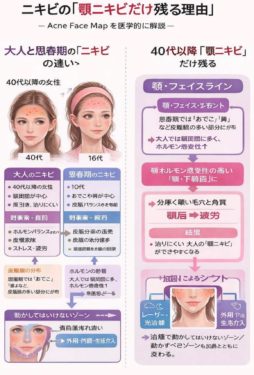
ただニキビはランダムにできているようで、実は皮脂腺分布・ホルモン感受性・生活接触の影響を強く受けている。「場所」から分かるのは、体質というより“負荷のかかり方”です。わかりやすく図にしたのですが、日本語の間違いはチャットGPTが苦手なところで、いつか改定しますね。
■ 前額・鼻(Forehead & Nose / Tゾーン)
特徴
皮脂腺が非常に多い
交感神経・ホルモンの影響を受けやすい
関連しやすい要因
睡眠不足・ストレス
高GI食・間食の頻度
洗いすぎ/触りすぎ
整髪料・前髪の接触
生活リズムと皮脂コントロールの乱れが最初に表れる場所
■ 生え際(Hairline)
特徴
外因性トラブルが多い部位
関連しやすい要因
ワックス・ポマード・スプレー
シャンプー残留
帽子・ヘルメットの蒸れ
ここは体内よりも「頭皮・ヘアケア由来」を疑う
■ 眉・眉間(Eyebrow Area)
特徴
毛包が深く、炎症が長引きやすい
関連しやすい要因
メイク残り
眉毛処理による毛包炎
皮脂+化粧品の混合刺激
水分摂取不足
スキンケアとメイク動線の見直しポイント
■ 頬(Cheeks)
特徴
皮脂は少なめだが、摩擦に弱い
関連しやすい要因
枕カバー・タオル
マスク
スマートフォン
無意識の頬杖
接触性・環境因子ニキビが多い
■ 顎・フェイスライン(Jawline & Chin)
最も重要な部位
特徴
アンドロゲン(男性ホルモン)感受性が高い
年齢とともに出やすくなる
関連しやすい要因
ホルモンバランスの変化
睡眠リズムの乱れ
慢性的な疲労・過労
過度なトレーニング・低栄養
「体内リズムの乱れ」が可視化される場所
■ 耳周囲・首(Ears / Neck)
特徴
洗い残し・アレルギー反応が出やすい
関連しやすい要因
シャンプー・トリートメント残留
ピアス・マスク紐
化粧品による接触皮膚炎
清潔=洗いすぎになりやすい盲点
このマップで誤解してはいけないのは、「ニキビの場所=特定の内臓の不調」ではないという点。
正しくは、皮脂腺の多さ
ホルモン受容体の分布
摩擦・接触・生活習慣
これらが重なった場所に炎症が出るというだけ。
結論
ニキビは
「肌の失敗」ではなく、生活の歪みが最初に現れる“可視化データ”だ。場所を見る。原因を整理する。生活を微調整する。
それができると、ニキビは「敵」ではなく、非常に優秀なモニターになる。
What the Location of Acne Can Tell Us
— A Medical Reinterpretation of the “Acne Face Map” —
Acne is often described as a symbol of youth. When people think about where acne appears, the most commonly cited example may be the playful idea of “love-related pimples” — thinking of someone, being thought of, being rejected, rejecting others.
However, acne does not occur randomly. In reality, its distribution is strongly influenced by sebaceous gland density, hormonal sensitivity, and lifestyle-related contact factors. What the location of acne reveals is not so much one’s constitution, but rather how and where physiological or environmental stress is being applied.
I have illustrated this concept in a simplified diagram. (Please forgive any awkward Japanese phrasing — that is one area where ChatGPT struggles; I will revise it someday.)
■ Forehead & Nose (T-zone)
Characteristics
-
Extremely high density of sebaceous glands
-
Highly sensitive to sympathetic nervous system activity and hormonal fluctuations
Commonly associated factors
-
Sleep deprivation and psychological stress
-
High–glycemic-index diets and frequent snacking
-
Excessive cleansing or frequent touching
-
Hair products and contact with bangs
This is often the first area where disruptions in lifestyle rhythm and sebum regulation become visible.
■ Hairline
Characteristics
-
Prone to exogenous (external) causes of irritation
Commonly associated factors
-
Wax, pomade, hair spray
-
Residual shampoo or conditioner
-
Occlusion and humidity from hats or helmets
In this area, causes related to scalp and hair care should be suspected before internal factors.
■ Eyebrow Area / Glabella
Characteristics
-
Deep hair follicles
-
Inflammation tends to persist longer
Commonly associated factors
-
Residual makeup
-
Folliculitis from eyebrow grooming
-
Combined irritation from sebum and cosmetics
-
Inadequate hydration
This area highlights the need to reassess skincare routines and makeup application/removal pathways.
■ Cheeks
Characteristics
-
Relatively low sebum production
-
Highly vulnerable to friction
Commonly associated factors
-
Pillowcases and towels
-
Face masks
-
Smartphones
-
Unconscious habits such as resting the face on one’s hand
Contact-related and environmental acne are particularly common here.
■ Jawline & Chin
The most clinically important area
Characteristics
-
High sensitivity to androgens
-
Tends to worsen with age
Commonly associated factors
-
Hormonal fluctuations
-
Disrupted sleep rhythms
-
Chronic fatigue and overwork
-
Excessive training and inadequate nutrition
This region visualizes disturbances in the body’s internal rhythm.
■ Ears & Neck
Characteristics
-
Prone to residue-related irritation and allergic reactions
Commonly associated factors
-
Residual shampoo or hair treatments
-
Earrings and mask straps
-
Contact dermatitis caused by cosmetics
A common blind spot where “cleanliness” easily turns into over-washing.
A Critical Point of Clarification
This acne map should not be misunderstood as implying
“a specific acne location equals dysfunction of a specific internal organ.”
Rather, inflammation appears where the following factors overlap:
-
Density of sebaceous glands
-
Distribution of hormone receptors
-
Friction, contact, and lifestyle-related exposures
Nothing more, nothing less.
Conclusion
Acne is not
a “failure of the skin.”
It is visualized data — an early warning signal reflecting distortions in daily life.
Observe the location.
Organize the possible causes.
Make small, targeted lifestyle adjustments.
When approached this way, acne stops being an “enemy”
and becomes an exceptionally intelligent monitoring system.