













TakahiroFujimoto.com

HOME MAIL
HOME PROFILE BOOKS MUSIC PAPERS CONFERENCES BLOG MAIL CLOSE

BLOG 藤本幸弘オフィシャルブログ

BLOG|ブログ

ニキビのできる場所が教えてくれること

ニキビの「できる場所」が教えてくれること

— Acne Face Map を医学的に読み替える —

青春のシンボルと言われてニキビですが、ニキビが出来る場所と言えば「思い、思われ、振り、振られ」ニキビぐらいが有名なんでしょうか。

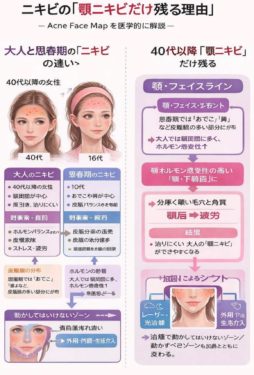
ただニキビはランダムにできているようで、実は皮脂腺分布・ホルモン感受性・生活接触の影響を強く受けている。「場所」から分かるのは、体質というより“負荷のかかり方”です。わかりやすく図にしたのですが、日本語の間違いはチャットGPTが苦手なところで、いつか改定しますね。

■ 前額・鼻(Forehead & Nose / Tゾーン)

特徴
皮脂腺が非常に多い
交感神経・ホルモンの影響を受けやすい
関連しやすい要因
睡眠不足・ストレス
高GI食・間食の頻度
洗いすぎ/触りすぎ
整髪料・前髪の接触

生活リズムと皮脂コントロールの乱れが最初に表れる場所

■ 生え際(Hairline)

特徴
外因性トラブルが多い部位
関連しやすい要因
ワックス・ポマード・スプレー
シャンプー残留
帽子・ヘルメットの蒸れ

ここは体内よりも「頭皮・ヘアケア由来」を疑う

■ 眉・眉間(Eyebrow Area)

特徴
毛包が深く、炎症が長引きやすい
関連しやすい要因
メイク残り
眉毛処理による毛包炎
皮脂+化粧品の混合刺激
水分摂取不足

スキンケアとメイク動線の見直しポイント

■ 頬(Cheeks)

特徴
皮脂は少なめだが、摩擦に弱い
関連しやすい要因
枕カバー・タオル
マスク
スマートフォン
無意識の頬杖

接触性・環境因子ニキビが多い

■ 顎・フェイスライン(Jawline & Chin)

最も重要な部位
特徴
アンドロゲン(男性ホルモン)感受性が高い
年齢とともに出やすくなる
関連しやすい要因
ホルモンバランスの変化
睡眠リズムの乱れ
慢性的な疲労・過労
過度なトレーニング・低栄養

「体内リズムの乱れ」が可視化される場所

■ 耳周囲・首(Ears / Neck)

特徴
洗い残し・アレルギー反応が出やすい
関連しやすい要因
シャンプー・トリートメント残留
ピアス・マスク紐
化粧品による接触皮膚炎

清潔=洗いすぎになりやすい盲点

このマップで誤解してはいけないのは、「ニキビの場所=特定の内臓の不調」ではないという点。
正しくは、皮脂腺の多さ
ホルモン受容体の分布
摩擦・接触・生活習慣
これらが重なった場所に炎症が出るというだけ。

結論

ニキビは
「肌の失敗」ではなく、生活の歪みが最初に現れる“可視化データ”だ。場所を見る。原因を整理する。生活を微調整する。
それができると、ニキビは「敵」ではなく、非常に優秀なモニターになる。
 

What the Location of Acne Can Tell Us

— A Medical Reinterpretation of the “Acne Face Map” —

Acne is often described as a symbol of youth. When people think about where acne appears, the most commonly cited example may be the playful idea of “love-related pimples” — thinking of someone, being thought of, being rejected, rejecting others.

However, acne does not occur randomly. In reality, its distribution is strongly influenced by sebaceous gland density, hormonal sensitivity, and lifestyle-related contact factors. What the location of acne reveals is not so much one’s constitution, but rather how and where physiological or environmental stress is being applied.

I have illustrated this concept in a simplified diagram. (Please forgive any awkward Japanese phrasing — that is one area where ChatGPT struggles; I will revise it someday.)


■ Forehead & Nose (T-zone)

Characteristics

  • Extremely high density of sebaceous glands

  • Highly sensitive to sympathetic nervous system activity and hormonal fluctuations

Commonly associated factors

  • Sleep deprivation and psychological stress

  • High–glycemic-index diets and frequent snacking

  • Excessive cleansing or frequent touching

  • Hair products and contact with bangs

This is often the first area where disruptions in lifestyle rhythm and sebum regulation become visible.


■ Hairline

Characteristics

  • Prone to exogenous (external) causes of irritation

Commonly associated factors

  • Wax, pomade, hair spray

  • Residual shampoo or conditioner

  • Occlusion and humidity from hats or helmets

In this area, causes related to scalp and hair care should be suspected before internal factors.


■ Eyebrow Area / Glabella

Characteristics

  • Deep hair follicles

  • Inflammation tends to persist longer

Commonly associated factors

  • Residual makeup

  • Folliculitis from eyebrow grooming

  • Combined irritation from sebum and cosmetics

  • Inadequate hydration

This area highlights the need to reassess skincare routines and makeup application/removal pathways.


■ Cheeks

Characteristics

  • Relatively low sebum production

  • Highly vulnerable to friction

Commonly associated factors

  • Pillowcases and towels

  • Face masks

  • Smartphones

  • Unconscious habits such as resting the face on one’s hand

Contact-related and environmental acne are particularly common here.


■ Jawline & Chin

The most clinically important area

Characteristics

  • High sensitivity to androgens

  • Tends to worsen with age

Commonly associated factors

  • Hormonal fluctuations

  • Disrupted sleep rhythms

  • Chronic fatigue and overwork

  • Excessive training and inadequate nutrition

This region visualizes disturbances in the body’s internal rhythm.


■ Ears & Neck

Characteristics

  • Prone to residue-related irritation and allergic reactions

Commonly associated factors

  • Residual shampoo or hair treatments

  • Earrings and mask straps

  • Contact dermatitis caused by cosmetics

A common blind spot where “cleanliness” easily turns into over-washing.


A Critical Point of Clarification

This acne map should not be misunderstood as implying
“a specific acne location equals dysfunction of a specific internal organ.”

Rather, inflammation appears where the following factors overlap:

  • Density of sebaceous glands

  • Distribution of hormone receptors

  • Friction, contact, and lifestyle-related exposures

Nothing more, nothing less.


Conclusion

Acne is not
a “failure of the skin.”

It is visualized data — an early warning signal reflecting distortions in daily life.

Observe the location.
Organize the possible causes.
Make small, targeted lifestyle adjustments.

When approached this way, acne stops being an “enemy”
and becomes an exceptionally intelligent monitoring system.



メンヘラって?

「メンヘラ」という言葉は、どこから来て、どこへ行ったのか?


「メンヘラ」という言葉を、私たちはあまりにも気軽に使っています。けれど、この言葉の正体をきちんと説明できる人は、実は多くありません。結論から言うと、メンヘラは病名でも性格でもありません。

もともとは、とても限定的で、どちらかといえば中立的な言葉でした。

語源は「メンタルヘルス」です
「メンヘラ」は

mental health(メンタルヘルス)
を日本語的に省略したネットスラングです。

2000年前後、2ちゃんねるの「メンタルヘルス板」に集まる人たちを指して、

メンヘル板の人
メンヘルな人

そこから転じて「メンヘラ」
と呼ばれるようになりました。

当初は、
うつ病
不安障害
PTSD
双極性障害

など、実際に精神的な困難を抱えている当事者を指す、比較的ニュートラルな呼び名だったのです。

ところが、この言葉は次第に意味を変えていきます。

感情の起伏が激しい
依存的に見える
不安を強く表現する
構ってほしい言動が多い

こうした「周囲が扱いづらいと感じる振る舞い」を、
ひとまとめにするラベルとして使われるようになりました。

ここで重要なのは、
医学的な定義は一切存在しない
という点です。

「メンヘラ」という言葉は、その人の内面を説明するためではなく、周囲の人が感じた“しんどさ”を言語化しただけの言葉なのです。

医師の立場から見ると、「メンヘラ」という言葉は、正直かなり粗いです。

なぜなら、その一言の裏側に、
愛着不安の強い人
トラウマ反応を抱えている人
気分障害の波の中にいる人
発達特性による感情調整の難しさ
など、全く異なる背景が混在しているからです。

同じ「不安定」に見えても、原因も、必要な支援も、回復の道筋も違います。それを全部まとめて「メンヘラ」と呼んでしまうのは、医療で言えば「全部まとめて腹痛ですね」と言っているようなものです。

それでも「メンヘラ」という言葉は消えません。
理由はシンプルで、便利だからです。

説明しなくていい
距離を取る理由になる
自分が傷つかずに済む

誰かを理解しないための言葉として、これほど手軽なものはありません。

一方で、その便利さの裏側で、
言われた側は「自分は厄介な存在なんだ」と学習していきます。

「メンヘラ」という言葉は、誰かを診断する言葉ではありません。それはむしろ、関係性の中で生まれた摩擦の名前です。そして多くの場合、「弱さ」ではなく生き延びるために身につけた反応が、たまたま今の社会に合っていないだけなのだと思います。

もしこの言葉を使うときは、その便利さの裏側に、説明されなかった物語があることだけは、少しだけ思い出してもいいのかもしれません。


Where Did the Word “Menhera” Come From, and Where Did It Go?

In Japan we often shorten a word and use it very casually. The word “menhera”  is one of those kinds.
Yet surprisingly few people can clearly explain what it actually means.
To state the conclusion first: menhera is neither a medical diagnosis nor a personality trait.

Originally, it was a very limited—and relatively neutral—term.

Its origin lies in the phrase “mental health.”
Menhera is a piece of Japanese internet slang derived from mental health.

Around the year 2000, it was used on the Japanese online forum 2channel to refer to people who gathered on the “Mental Health” board:

  • people from the mental health board

  • people who were “menheru”

From there, the term evolved into “menhera.”

At first, it referred quite neutrally to individuals who were genuinely dealing with psychological difficulties, such as:

  • depression

  • anxiety disorders

  • PTSD

  • bipolar disorder

However, over time, the meaning of the word began to shift.

It came to be used as a catch-all label for behaviors that others found difficult to handle:

  • intense emotional ups and downs

  • appearing dependent

  • strongly expressing anxiety

  • frequent attention-seeking behavior

What matters here is this:
there is no medical definition whatsoever for menhera.

The word does not describe a person’s inner world.
Rather, it merely puts into words the discomfort felt by those around them.

From a medical perspective, the term menhera is, frankly, extremely crude.

That is because behind this single label lie entirely different backgrounds:

  • people with strong attachment anxiety

  • people experiencing trauma responses

  • people caught in the waves of mood disorders

  • people struggling with emotional regulation due to neurodevelopmental traits

Even if they all appear “unstable,” the causes, the necessary support, and the paths to recovery are completely different.
Lumping all of this together under the word menhera is like saying, in medicine, “Well, it’s all just stomach pain.”

And yet, the word refuses to disappear.
The reason is simple: it is convenient.

  • You don’t have to explain.

  • It gives you a reason to keep your distance.

  • It protects you from getting hurt.

Few words are as easy to use when you want not to understand someone.

On the other hand, behind that convenience, the person being labeled gradually learns:
“I am a troublesome existence.”

The word menhera is not a diagnosis of someone.
Rather, it is the name given to friction that arises within a relationship.
And in many cases, what is being labeled is not “weakness,” but reactions that were once necessary for survival and simply do not fit well with today’s society.

If we choose to use this word, perhaps it is worth remembering—just a little—that behind its convenience lies a story that was never told.


SNS にいかに騙されるか

人がSNSにいかに簡単に騙されるか?

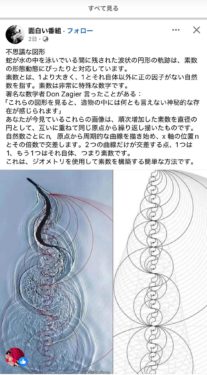
今朝見つけたSNSの投稿。良いねもたくさんついています。でも数学的知識がある人がちょっと考えればこの投稿の間違いに気づきます。

医学や数学など、情報の非対称性がある分野はこんな事が多いですよね。

素数ほど、定義が簡潔な対象はありません。

1とそれ自身以外に正の約数を持たない数。

小学生にも説明できるこの定義から、数千年にわたる未解決問題が連鎖的に生まれている。この定義の透明性と、振る舞いの不透明性の落差こそが、人間の知性を強く刺激しているのだと思います。

ーーーーーー

不思議な図形と素数 ― 何が正しく、何が違うのか

この投稿で描写されている内容は、「素数を幾何学的に“発見した”」というよりも、「既知の算術構造を幾何学に“翻訳した”」ものです。

① 素数の定義について
素数とは、1より大きく、1とそれ自体以外に正の因子がない自然数
これは完全に正しい定義です。

② 「蛇が水中に残す波状の円形軌跡」について

この比喩は詩的ですが、数学的には
正弦波
周期曲線
円の重ね描き
といった周期関数の干渉パターンを指していると考えられます。
しかし重要なのは、素数がこの幾何学構造から“必然的に生成される”わけではない
という点です。

③ 「2つの曲線だけが交差する点=素数」なのか?
ここが最大の誤解です。

この投稿が述べている構造は、実質的に
各自然数 n に対応する周期関数
交点が n の約数を表す
約数が 2 個(1 と n)のときに素数
という、約数判定を幾何的に可視化したモデルです。

つまりこれは約数構造を幾何学に写像したという関係にあります。

美しさは、真理の副産物ではない。

真理が人間の知覚に触れたときに生まれる現象である。

数学者が素数に魅了され、芸術家が素数を題材にし、哲学者がそこに意味を見出す理由は、まさにここにありますね。


How Easily People Can Be Misled on Social Media

A post I found on social media this morning. It has received many likes.
However, anyone with even a little mathematical knowledge will notice the mistake in this post after giving it some thought.

In fields such as medicine or mathematics, where information asymmetry is large, this kind of thing happens quite often.

There are few objects with a definition as simple as that of prime numbers.

A number that has no positive divisors other than 1 and itself.

From this definition—simple enough to explain to an elementary school student—an entire chain of unsolved problems spanning thousands of years has emerged.
I believe it is precisely this gap between the transparency of the definition and the opacity of the behavior that so powerfully stimulates human intelligence.


Mysterious Shapes and Prime Numbers — What Is Correct and What Is Not

What is depicted in this post is not so much a case of “discovering prime numbers geometrically,” but rather of “translating known arithmetic structures into geometry.”

① Definition of prime numbers
A prime number is a natural number greater than 1 that has no positive divisors other than 1 and itself.
This definition is completely correct.

② “Circular wave-like traces left by a snake moving through water”

This metaphor is poetic, but mathematically it can be understood as referring to:

  • sine waves

  • periodic curves

  • superimposed circles

In other words, interference patterns of periodic functions.
What is important, however, is that prime numbers are not necessarily generated from these geometric structures.

③ “Points where only two curves intersect = prime numbers?”
This is the biggest misunderstanding.

The structure described in the post is essentially:

  • a periodic function corresponding to each natural number n

  • intersection points representing the divisors of n

  • numbers with exactly two divisors (1 and n) being prime

In other words, it is a model that geometrically visualizes divisor testing.

This means that what we are seeing is a mapping of arithmetic divisor structures into geometry.

Beauty is not the source of truth.

It is a phenomenon that arises when truth comes into contact with human perception.

This is precisely why mathematicians are fascinated by prime numbers, artists take them as a theme, and philosophers find meaning in them.


2025年の軌跡

2025年の軌跡


右足骨折 クアラルンプール グアム パリ ニューヨーク フィラデルフィア マラガ ヘルシンキ ハワイ バンコク ロンドン コペンハーゲン ビルバオ チュニジア エジプト リヤド ジェッダ メディナ マニラ 香港 マカオ パラオ


The Journey of 2025

A broken right foot
Kuala Lumpur, Guam, Paris, New York, Philadelphia, Málaga, Helsinki, Hawaii, Bangkok, London, Copenhagen, Bilbao, Tunisia, Egypt, Riyadh, Jeddah, Medina, Manila, Hong Kong, Macau, Palau


縄文と文明

縄文は文明ではない?

文明とは何か。

そして、日本列島はいつ文明になったのか。
この問いは、意外なほど曖昧なまま語られている。

文明の条件に「文字」は含まれるのか
結論から言えば、多くの学術的定義では「文字」は文明の中核条件に含まれる。

都市、国家、余剰生産、階層社会、宗教、技術。
そして最後に置かれるのが、文字=記録システムである。

文字は単なるコミュニケーション手段ではない。
それは、

法を固定し
契約を永続させ
税を管理し
知識を個人の寿命から切り離す
文明を“時間的に持続させる装置”だ。

この視点に立つと、ある結論が避けられなくなる。
縄文時代は文化であり、文明ではない
学術的分類において、
縄文時代は文明ではなく「高度な文化社会」と位置づけられる。
なぜか。

国家がない
都市がない
階層が固定していない
文字がない
税や法の記録がない

文明のチェックリストを、縄文は満たさない。

しかし、ここで思考を止めてはいけない。

縄文は「未発達」だったのか?

答えは明確に 否 である。

縄文社会は、約1万年以上続いた
狩猟採集でありながら定住した
世界最古級の土器と漆器を持った
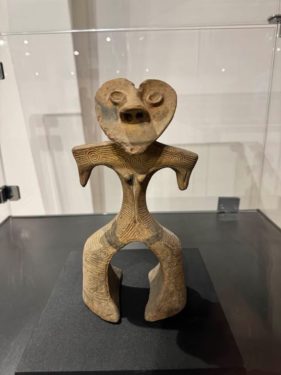
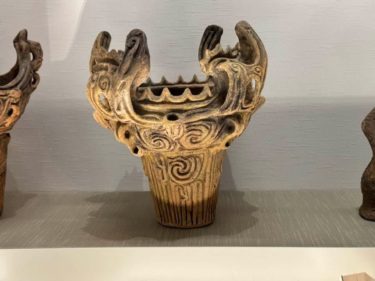
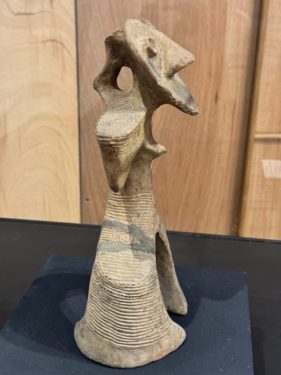
精緻な精神文化(土偶・環状列石)を残した
文明社会の多くが数百〜数千年で崩壊する中、縄文は驚異的な安定性を示した。

これは「文明に至れなかった」のではない。

文明を必要としなかった社会だった。
なぜ必要としなかったのか

理由は単純で、そして決定的だ。

食料環境が豊かだった
人口圧が上がらなかった
顔の見える共同体規模を保てた

つまり、文字・法・国家という“支配装置”を
導入する必然が存在しなかった

文字は便利だが、同時にコストでもある。
縄文は、そのコストを払う理由がなかった。

文明は「上位概念」ではない

まず、ここをはっきりさせておく必要があります。

文明(civilization)
文化(culture)

この二つは
上下関係ではなく、設計思想の違いです。

文明は、
拡張に強い
人口増加に耐える
顔の見えない他者を管理できる

代わりに、
支配装置が必要
文字・法・税が不可欠
崩壊リスクが常に内在する

縄文は「低速・高安定モデル」
縄文社会を工学的に言い換えると、
スループットを極限まで落とし、
フェイルセーフを最大化した社会
です。

成長しない
集中しない
記録しない
加速しない

しかしその結果、約1万年以上持続
環境破壊を起こさない
階層固定が起きない
これは失敗ではなく、
意図せず到達してしまった最適解に近い。

文明と別形態だと分かる決定的ポイント

一番の違いは、ここです。

文明
問題が起きたら「制度を足す」
不安が出たら「管理を強める」
記録で未来を縛る

縄文
問題が起きない規模を保つ
不安が出ない関係性を保つ
記録せず、循環に任せる

つまり、
文明は「制御型システム」
縄文は「自己安定型システム」

とも言えるのです。


Was Jōmon Not a Civilization?

What is civilization?

And when did the Japanese archipelago become one?

Surprisingly, this question is often discussed without a clear definition.


Does Civilization Require Writing?

In most academic definitions, the answer is yes.
Writing is considered a core condition of civilization.

Cities, states, surplus production, social stratification, religion, technology—
and finally, writing: a system of record-keeping.

Writing is not merely a means of communication.
It is a device that:

  • fixes laws

  • preserves contracts

  • administers taxation

  • separates knowledge from individual lifespans

In short, it allows civilization to persist through time.

Seen from this perspective, a certain conclusion becomes unavoidable.


Jōmon Was a Culture, Not a Civilization

In academic classification, the Jōmon period is not regarded as a civilization,
but as a “highly developed cultural society.”

Why?

  • No state

  • No cities

  • No fixed social hierarchy

  • No writing

  • No recorded systems of law or taxation

By the conventional checklist, Jōmon does not qualify as civilization.

But we must not stop thinking here.


Was Jōmon “Underdeveloped”?

The answer is clearly no.

Jōmon society:

  • endured for over 10,000 years

  • was sedentary despite being hunter-gatherer

  • produced some of the world’s earliest pottery and lacquerware

  • left behind sophisticated spiritual culture (dogū figurines, stone circles)

While many civilizations collapsed within hundreds or a few thousand years,
Jōmon demonstrated extraordinary stability.

This was not a society that failed to reach civilization.

It was a society that did not need civilization.


Why Was Civilization Unnecessary?

The reasons are simple—and decisive.

  • Food resources were abundant

  • Population pressure remained low

  • Communities stayed at a scale where everyone was visible

In other words, there was no necessity to introduce
the “control mechanisms” of writing, law, and the state.

Writing is convenient, but it is also costly.
Jōmon had no reason to pay that cost.


Civilization Is Not a Higher Concept

This point must be made explicit.

Civilization and culture are not in a hierarchy.
They represent different design philosophies.

Civilization is:

  • resilient to expansion

  • capable of sustaining population growth

  • able to manage anonymous others

But in exchange:

  • it requires systems of control

  • writing, law, and taxation become indispensable

  • the risk of collapse is always inherent


Jōmon as a “Low-Speed, High-Stability Model”

Translated into engineering terms, Jōmon society was a system that:

  • minimized throughput

  • maximized fail-safes

It did not:

  • pursue growth

  • concentrate power

  • record everything

  • accelerate endlessly

As a result:

  • it lasted for over 10,000 years

  • it did not cause environmental destruction

  • fixed social hierarchies did not emerge

This was not failure.
It was close to an unintended optimum.


The Decisive Difference

The most fundamental distinction lies here.

Civilization

  • adds systems when problems arise

  • strengthens control when anxiety increases

  • binds the future through records

Jōmon

  • maintains a scale where problems do not arise

  • preserves relationships that do not generate anxiety

  • does not record, leaving continuity to cycles

In this sense:

Civilization is a control-oriented system.
Jōmon was a self-stabilizing system.



カテゴリー