













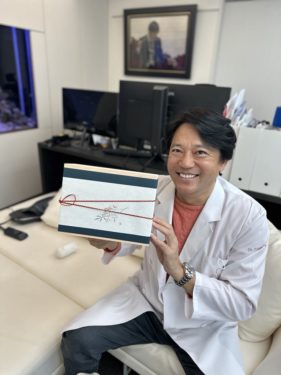
シーラカンス最中と山本山のりせんべい。


A gift I received: Coelacanth monaka and Yamamotoyama nori rice crackers.

 藤本幸弘オフィシャルブログ
シーラカンス最中と山本山のりせんべい。
A gift I received: Coelacanth monaka and Yamamotoyama nori rice crackers.
インドに行ったスタッフがくれました。
一体何が入っているんだ???

A staff member who went to India gave this to me. What on earth is inside this???
本日はゴルフ医科研にて、ゴルフandカラオケの、「女医サウンド」の会。
女医さんと一緒のカラオケなら、「Joysound」ではなく、「女医サウンド」だろうと命名された会ですが、本日は女医さんが参加してくれましたので、成立。
15名で先ほどまでシミュレーションゴルフとカラオケで盛り上がりました!
僕のゴルフスイング物理数式の講演も、ドローとフェードの打ち分け方法。
数式使って、なぜドローとフェードが打てるのか、解説しました。


ワインもこの数空きました!

楽しかったー!
Today at the Golf Medical Science Institute, we held a “Golf & Karaoke” gathering called “Jo-i Sound” (a play on Joysound). The name came from the idea that if you’re doing karaoke with a woman doctor, it shouldn’t be “Joysound” — it should be “Jo-i Sound” (“Lady Doctor Sound”). And since a woman doctor actually joined us today, the event officially lived up to its name.
Fifteen of us enjoyed simulation golf and karaoke together until just a short while ago — it was a great time!
I also gave a lecture on the physics equations behind my golf swing, explaining how to intentionally hit draws and fades. Using actual formulas, I broke down why it’s possible to produce a draw or a fade.
And we went through this many bottles of wine!
It was so much fun!
実はこの1年間体重計に乗っていませんでした。
海外出張で会食も無く、あまり食べなかったので、痩せました。
最近会う人皆が痩せたというので、昨日楽しみに乗ったら、なんと一年前から1キロ増。
いったいどのぐらい太ってたんだ。笑。
2025年1月の写真です
若林顕のベートーヴェンピアノソナタ
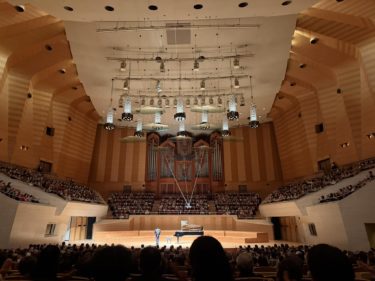
サントリーホールでの若林顕のピアノコンサートに足を運んだ。
プログラムは、いわば「ピアノの新約聖書」。ベートーヴェンのピアノソナタから五曲。バッハが旧約なら、ベートーヴェンは新約。ピアノという楽器に人格を与え、苦悩と歓喜、孤独と超克を語らせた存在である。
若林顕の演奏は、その「物語」をただ再現するのではなく、再び生きさせる。彼はしばしばヴィルトゥオーゾと称される。
だがその意味は、単なる超絶技巧ではない。長時間弾いても一向に衰えない強靭な打鍵も含まれるのだろう。今回の演奏会も、一曲一曲調子が上がり、後半の演奏の方が確実に素晴らしかった。
最後は熱情。《熱情》の最終楽章は凄い。
第3楽章 Allegro ma non troppo。
静かに、しかし不穏に始まるあの分散和音。嵐の前の、低い地鳴りのような震え。そこから一気に加速する。この楽章は、歌わない。祈らない。立ち止まらない。ただ、突き進む。
ベートーヴェンが書いたのは「美しい旋律」ではなく、「運動」そのものだ。エネルギーが連鎖し、和声が前へ前へと押し出される。若林顕の演奏は、ここで真価を見せる低音は鋼のように重く、高音は閃光のように鋭い。
そして、あの終結部。プレスト。
終止和音に叩きつけられる瞬間、燃え尽きる覚悟の音だった。《熱情》の最終楽章は、ロマン派の感傷ではない。
古典の枠を押し広げる、革命の音である。音が終わった瞬間、会場の空気が一瞬止まった。呼吸を忘れるとは、あのことだ。
ベートーヴェンは二百年以上前の作曲家だが、その新約は、いまも更新され続けているのだろう。
ピアノ・ソナタ 第8番「悲愴」八短調 op.13
Sonate für Klavier Nr.8 “Pathetique” c-moll op. 13
ピアノ・ソナタ 第17番「テンペスト」二短調 op.31-2
Sonate fur Klavier Nr.17 d-moll op.31-2
ピアノ・ソナタ 第21番「ワルトシュタイン」バ長調 op.53
Sonate für Klavier Nr.21 “Waldstein” C-Dur op.53
ピアノ・ソナタ 第14番「月光」嬰八短調 op.27-2
Sonate für Klavier Nr. 14 “Sonata quasi una fantasia”
(Mondscheinsonate) cis-moll op.27-2
ピアノ・ソナタ 第23番「熱情」へ短調 op.57
Sonate für Klavier Nr.23 “Appassionata” f-moll op.57
アンコール
シューマン=リスト:「献呈」
バッハ=シロッティ:プレリュード ロ短調
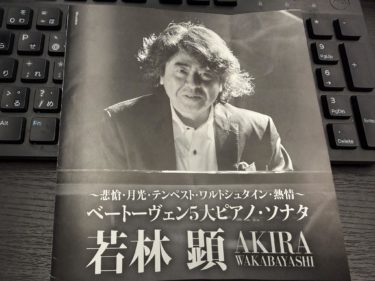
Akira Wakabayashi’s Beethoven Piano Sonatas
I went to hear Akira Wakabayashi’s piano recital at Suntory Hall.
The program was, so to speak, the “New Testament of the piano”: five sonatas by Beethoven. If Bach is the Old Testament, then Beethoven is the New. He was the one who gave the piano an inner life, who made it speak of anguish and joy, solitude and transcendence.
Wakabayashi’s performance does not merely reproduce that “story”—he makes it live again. He is often described as a virtuoso.
But that does not simply mean dazzling technique. It surely also includes the powerful touch that does not weaken even after long stretches of playing. In this recital as well, each piece seemed to build in intensity, and the performances in the second half were unmistakably even more magnificent.
The finale was the Appassionata. The final movement of the Appassionata is astounding.
Third movement: Allegro ma non troppo.
It begins quietly, yet ominously, with those broken chords—like the low rumbling of thunder before a storm. Then it accelerates all at once. This movement does not sing. It does not pray. It does not pause. It simply presses forward.
What Beethoven wrote here is not a “beautiful melody,” but motion itself. Energy sets off a chain reaction, and the harmonies drive relentlessly onward. In this movement Wakabayashi reveals his true power: the bass like steel in its weight, the treble sharp as flashes of lightning.
And then, that conclusion—Presto.
At the instant the final chords were hurled down, the sound carried a resolve to burn itself out. The last movement of the Appassionata is not Romantic sentimentality. It is the sound of revolution, pushing against the boundaries of Classicism. The moment the final note ended, the air in the hall froze. To forget to breathe—that is exactly what it was.
Beethoven composed more than two hundred years ago, yet his New Testament continues to be rewritten even now.
Program
Piano Sonata No. 8 in C minor, Op. 13 “Pathétique”
Piano Sonata No. 17 in D minor, Op. 31 No. 2 “Tempest”
Piano Sonata No. 21 in C major, Op. 53 “Waldstein”
Piano Sonata No. 14 in C-sharp minor, Op. 27 No. 2 “Moonlight”
Piano Sonata No. 23 in F minor, Op. 57 “Appassionata”
Encore
Schumann–Liszt: Widmung
Bach–Siloti: Prelude in B minor